Ortakoy sits on the European shore of the Bosphorus, roughly halfway between the old city and the Black Sea, and its history is written in the water at its doorstep. For most of its life it was a quiet fishing village with a small Greek and Armenian population, serving the ferry traffic and the market gardens of the shore. The nineteenth century transformed it into a fashionable Ottoman suburb, and the twentieth made it one of the most desirable addresses in Istanbul. Understanding that arc — from village to resort to postcard — is the key to reading the neighborhood today.
The Village Years: Fishing and Ferries
The name Ortakoy means “middle village,” and for centuries that is exactly what it was: a settlement midway along the European shore, its life organized around the water. The fishermen worked the strait, the market boats carried produce to the city, and the ferry landings connected the village to the Asian shore. The houses were modest wooden structures, and the population was a mix of Ottoman Muslims, Greeks, and Armenians, each community with its own church or mosque along the waterfront. The village’s rhythm — dawn fishing, midday market, evening tea on the shore — survives in muted form to this day.
The Nineteenth Century: The Sultan’s Waterfront
The turning point came in the nineteenth century, when the Ottoman court began building along the Bosphorus. The sultans and their ministers raised ornate yalı mansions on the shore, and the fashionable life of Istanbul migrated to the waterfront. In 1853, Sultan Abdülmecid commissioned the Büyük Mecidiye Camii — the Ortakoy Mosque — a jewel of the Ottoman baroque style, designed by the Armenian architect Garabet Balyan and built at the very edge of the water. The mosque’s silhouette, with its slender minarets and delicate dome, became the symbol of the village, and the shore behind it filled with the palaces and pavilions of the court.

The Bridge Changes Everything
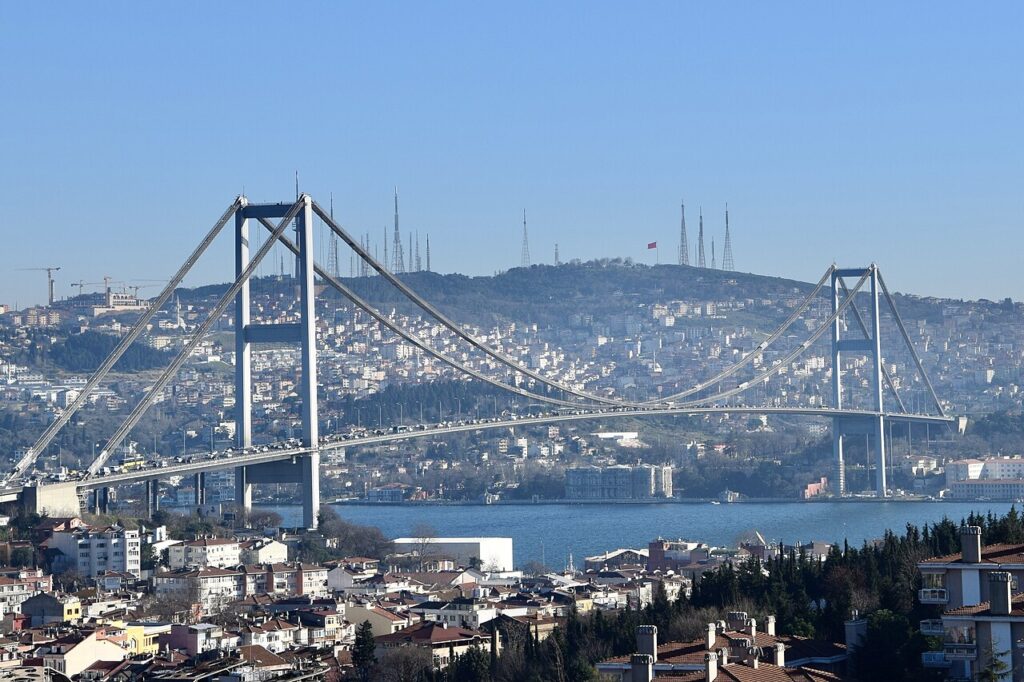
The modern history of Ortakoy begins with the Bosphorus Bridge, opened in 1973 and renamed the 15 Temmuz Şehitler Bridge after the 2016 coup attempt. The bridge’s European anchorage stands directly above the village, and its construction transformed Ortakoy from a sleepy shore suburb into one of the most recognizable views in Turkey. The mosque that once stood alone at the water’s edge now shares the frame with one of the great engineering works of the twentieth century, and the combination — the baroque dome and the steel span — is the image of modern Istanbul that circulates around the world.
The Modern Village: Cafes and Strollers
Today Ortakoy is a weekend destination for Istanbul residents and a mandatory stop for visitors. The square fills with kumpir stalls and souvenir stands, the waterfront promenade draws joggers and families, and the back streets have sprouted specialty coffee shops and design boutiques. The village has become a place to be seen — the strollers and the dogs, the brunch tables and the sunset selfies — and its social life spills onto the pavement from morning to midnight. The gentrification has critics, who mourn the loss of the old village character, but the energy is undeniable, and the mosque still anchors the scene with its quiet dignity.
The Cultural Life: Religion and Rhythm
The cultural life of Ortakoy is built on small rituals repeated daily. The call to prayer from the mosque’s minarets marks the day’s rhythm, and the square empties briefly at prayer times. Friday brings the weekly market up the hill, where the residents still buy their vegetables from the growers of the surrounding farms. The tea gardens fill in the late afternoon, and the evening belongs to the waterfront — the families strolling, the fishermen casting from the shore, the ferries crossing with their lights strung across the strait. The village’s festivals are the city’s: Ramadan evenings bring lanterns and sweets to the square, and national holidays light up the bridge.
The Identity: Between the Water and the World
What makes Ortakoy culturally distinct is its position between two worlds. It looks across the strait to the Asian shore, and its ferries carry commuters between continents every few minutes. It sits at the foot of the bridge that carries the traffic of Europe and Asia overhead. And it hosts the mixture of residents and visitors, of fishermen and fashion, of mosque and café, that defines contemporary Istanbul itself. Ortakoy is the Bosphorus distilled — the village that became a symbol without quite ceasing to be a village.

The Fishermen and the Commuters
The culture of Ortakoy runs on the water traffic, and two groups define it: the fishermen and the commuters. The fishermen have worked the strait since the village was a hamlet, casting from the shore and selling the morning catch from the boats; the commuters are the modern village’s pulse, crossing by ferry between the continents on their way to work. Watch the ferry landing in the morning and you see both at once — the old men with their lines at the water’s edge, the office workers with their coffees hurrying past. The two rhythms, the ancient and the daily, are the culture of the village in motion, and neither shows any sign of stopping.
The Village in the Arts
Ortakoy has a modest but real place in Turkish culture. The mosque and the bridge appear in countless films and television series, and the square has been the backdrop for music videos, wedding photographs, and the opening shots of documentaries about the city. Turkish pop songs name-check the village as shorthand for romance and the good life, and the postcard image of the mosque against the bridge is one of the most reproduced views of Turkey. The village has become, in a small way, the face the country shows the world — which is why its preservation matters, and why the residents guard its character so fiercely.

The Modern Debates
Like every beloved neighborhood, Ortakoy lives with the tension between preservation and change. The residents debate the development along the shore, the pressure of the weekend crowds, and the fate of the old wooden houses that survive in the back streets. The village’s status as a symbol makes the debate sharper — the image of the mosque and the bridge belongs to everyone, but the streets behind it belong to the people who live there. The balance the village has struck so far — the waterfront for the visitors, the back streets for the residents — is fragile but real, and the result is a neighborhood that feels both famous and lived-in. For the visitor, the lesson is to respect the division: enjoy the postcard, and leave the village’s everyday life to the people who guard it.
The cultural takeaway is the village’s persistence. Ortakoy has been a fishing village, a royal suburb, a symbol of modernization, and a postcard, and it has absorbed each identity without losing the one before it. The fishermen still work the shore beside the bridge that carries a continent’s traffic; the mosque still anchors the square that the cruise crowds fill; the village still runs on the water’s rhythm beneath the weight of its own image. That layered persistence is the culture of Ortakoy, and it is the reason the village feels both ancient and alive. The visitor who reads the layers — the water, the mosque, the bridge, the crowds — reads the whole story of the Bosphorus in a single glance.
The Takeaway
Ortakoy’s history is the history of the Bosphorus in miniature: a fishing village, a royal waterfront, a symbol of modern Istanbul, and now a living postcard. The mosque and the bridge tell the story in a single glance, but the village behind them — the streets, the market, the tea gardens, the daily rhythm of the water — is where the culture actually lives. Spend an hour with the postcard, and then walk into the village for the rest.
Frequently asked questions
What does the name Ortakoy mean?
It means “middle village,” reflecting its position halfway along the European shore of the Bosphorus.
When was the Ortakoy Mosque built?
The Büyük Mecidiye Camii was commissioned by Sultan Abdülmecid and completed in 1853, designed by the Balyan family of Ottoman court architects.
Why is the bridge called the 15 Temmuz Bridge?
It was renamed in honor of the victims of the July 15, 2016 coup attempt; it was previously known as the Bosphorus Bridge.
Is Ortakoy still a residential neighborhood?
Yes — the back streets are home to a wealthy residential community, while the waterfront belongs to visitors and weekend crowds.
Was Ortakoy ever a Greek or Armenian village?
Yes — the village had significant Greek and Armenian communities, each with its own houses of worship along the waterfront, until the population exchanges and migrations of the twentieth century.
Why do the wealthy of Istanbul choose Ortakoy?
The combination of the waterfront, the central location, and the village atmosphere has made it one of the most desirable addresses in the city.

All Over Information
The All Over Information editorial team researches and writes practical English-language guides to Turkey. Facts are checked against official and local sources before publication, prices are published as dated ranges rather than quotes, and guides are revised when things change. We accept no sponsored posts, paid placements or paid links.
More guides like this

Nightlife Guide to Ortakoy
Ortakoy is not the nightlife district of Istanbul — the clubs and the loud bars belong to the modern quarters — but…

Ortakoy in Summer: A Complete Travel Guide
Summer is Ortakoy's liveliest season — the long days, the full square, the kumpir stalls at their busiest, the ferries crossing through…
Shopping Guide: What to Buy in Ortakoy
Ortaköy is one of the most compact shopping districts in Istanbul, and that is exactly why it works.
Ortakoy in Winter: What to Expect
Winter changes Ortakoy the way it changes every waterfront — the crowds thin, the square returns to the village, and the strait…

Family-Friendly Activities in Ortakoy
Ortakoy is a family village — safe, small, and full of the things children actually enjoy.
48 Hours in Ortakoy: The Perfect Itinerary
Two days in Ortakoy is the Bosphorus life at its fullest — the village's square and shore, the mosque and the bridge,…