In Islamic civilization, the written word is also an art, and Ottoman calligraphy raised that art to one of its highest peaks. For six centuries, the scribes and masters of Istanbul turned letters into living forms, writing the Quran, imperial documents, and poetry in scripts of breathtaking beauty. Though the calligrapher’s guild faded with the empire, the tradition never died, and today Ottoman calligraphy is experiencing a vivid revival. This article traces the art from its origins to its modern renaissance.
The Art of the Written Word
Calligraphy, the art of beautiful handwriting, holds a unique place in Islamic culture. Because the depiction of living beings was discouraged in religious contexts, the written word became the primary vehicle for sacred art, and the Quran itself was written to be looked at as well as read. The Arabic script, with its flowing curves and vertical accents, proved a perfect medium, and over the centuries calligraphers developed an extraordinary range of styles.
In the Ottoman world, calligraphy was called the art of the pen, and it was ranked as the most noble of the arts. The calligrapher’s craft demanded years of study, a spiritual discipline, and a steady hand, and the great masters were venerated figures, their works treasured and imitated. The written word was everywhere: in mosques, on monuments, on documents, and in books, so the art shaped the visual environment of the entire empire.
The Scripts of the Ottoman World
The Ottoman calligraphers inherited a rich repertoire of scripts and refined them. The Thuluth and Naskh scripts dominated: Thuluth for its majestic monumental forms, used in mosque inscriptions and chapter headings, and Naskh for its clear, elegant bookhand, used for the Quran and other manuscripts. Each script had its rules of proportion, its rhythms, and its masters, and a calligrapher was expected to command several.
Beyond these, the Ottoman tradition cultivated specialist scripts. The Diwani script was developed for imperial decrees, its dense, interweaving forms almost a code that only the initiated could read quickly. The Taliq and Riq’a scripts served Persianate poetry and everyday correspondence, and the Jali variations were the large, bold forms used for public inscriptions. Each script is a world in itself, and part of the pleasure of the art is learning to distinguish them.

The Line of the Masters
Ottoman calligraphy is a tradition of apprenticeship and lineage, passed from master to student in an unbroken chain. The great masters trained under earlier masters, and their works acknowledge their teachers in their signatures, so that every calligrapher can trace his or her art back through the centuries. The most celebrated figures, such as Sheikh Hamdullah in the fifteenth century and Hafiz Osman in the seventeenth, redefined the scripts and set standards that later generations followed.
Sheikh Hamdullah, who worked at the court of Bayezid II, is credited with establishing the Ottoman canon of the Naskh and Thuluth scripts, and his style dominated for two centuries. Hafiz Osman, a century and a half later, brought the scripts to a new level of refinement, and his Quran manuscripts were copied for generations. The lineage continues to this day, with modern masters tracing their training back to these founders through a documented chain of teachers.
The Great Calligraphers of the Classical Age
The classical age of Ottoman calligraphy, from the sixteenth through the eighteenth centuries, produced a constellation of masters. The court workshops and the teaching mosques of Istanbul trained generation after generation, and the city became the calligraphy capital of the Islamic world. Calligraphers wrote the monumental inscriptions of the great mosques of Sinan, the imperial firmans and edicts, and the Quran manuscripts that are among the finest ever made.
Names such as Ahmed Karahisari, who brought the Aklam-i Sitte, the six classic scripts, to an unrivaled perfection, and the many masters of the later centuries filled albums and mosque walls with their work. Their calligraphy was not merely decoration; it was theology, poetry, and law made visible, and the finest works were believed to carry a kind of divine grace. The classical masters set the standard that the revival still looks back to.
Calligraphy in the Mosques and Monuments
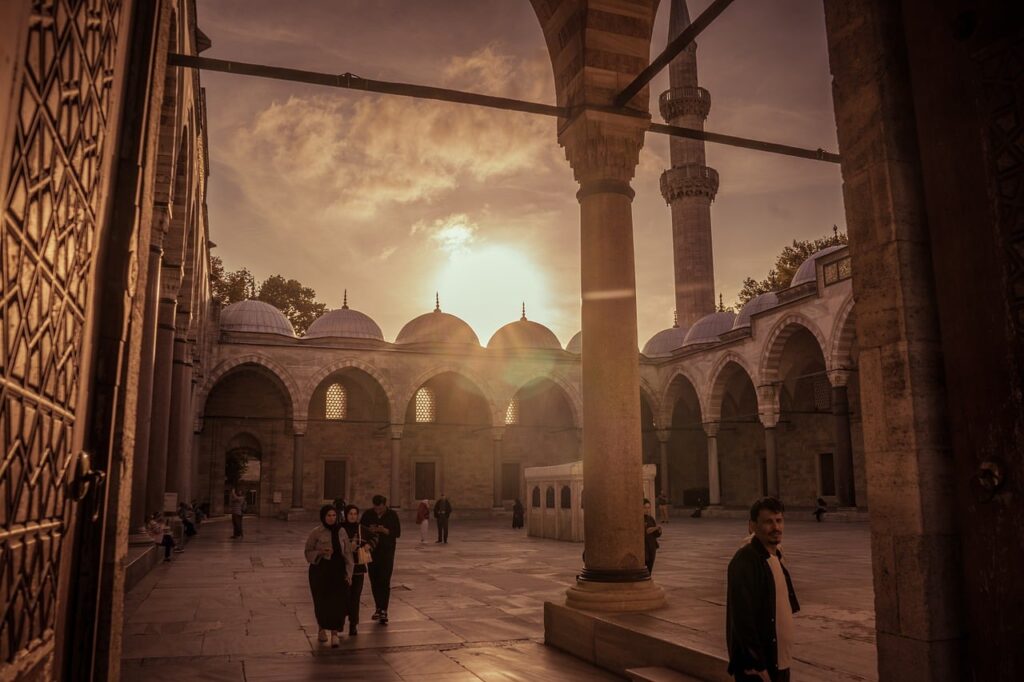
The most public face of Ottoman calligraphy is the monumental inscription. The great mosques of Istanbul and the provinces are covered in calligraphy: the giant roundels of the Hagia Sophia, the tile panels of the Blue Mosque, the domes and arches where the verses of the Quran are written in huge, flowing letters. These inscriptions were the work of the greatest masters, and they turn the buildings into books that believers and visitors read as they look.
Beyond the mosques, calligraphy appears on fountains, gates, tombstones, and imperial monuments across the empire, so that a walk through any Ottoman city is a walk through a gallery of the art. The tombstones of Istanbul’s cemeteries, carved with elegant inscriptions, are a particular treasure, recording names, dates, and prayers in the most refined forms. For the modern traveler, reading the surfaces of the city is one of the deepest pleasures of visiting Istanbul.
The Tools and Materials
Ottoman calligraphy is an art of the hand, and its tools are simple but demanding. The reed pen, cut and shaped by the calligrapher, is the heart of the craft; the ink, traditionally made from soot and gum, must flow evenly; and the paper, sized and burnished, must accept the strokes without blotting. The calligrapher prepares each tool personally, and the cutting of the pen was itself a skill within the skill.
The writing surface carried its own rituals. Manuscripts were often illuminated with gold and color by separate artists, so that calligraphy and miniature painting together created the complete book. The composition of a page, the placing of the text block, the balance of space, all followed conventions refined over centuries. Even the signatures and colophons, where the calligrapher recorded his name and date, were shaped into small works of art.

Decline in the Modern Era
The twentieth century dealt the tradition heavy blows. The adoption of the Latin alphabet in 1928 cut the living connection between daily life and the old scripts, and the revolutionary changes of the new republic swept away the institutions of the Ottoman world, including many of its calligraphic traditions. The number of practicing masters shrank, and the art risked becoming a relic, studied by historians rather than practiced by artists.
Yet the art never fully died. A small circle of masters kept the tradition alive through the difficult decades, teaching privately and writing for those who still valued the craft, and the Quran continued to be written and printed in the classical scripts. The calligraphers of the twentieth century maintained the chain of transmission, so that when the revival came, there were living teachers ready to pass the art on.
The Modern Revival
In recent decades, Ottoman calligraphy has enjoyed a remarkable renaissance. The art is now taught in dedicated institutions and workshops, where a new generation of students, including many women, studies under masters who trace their training to the classical line. Exhibitions of contemporary calligraphy fill Istanbul’s galleries, and the art has been reinterpreted in bold new forms, from enormous experimental compositions to design and digital media.
The revival is visible in the city’s cultural life. The Research Center for Islamic History, Art and Culture and other institutions have documented and published the tradition, and calligraphy classes are open to visitors and residents alike. Young calligraphers are experimenting with scale, color, and abstraction while honoring the classical rules, and the art has found new audiences worldwide. The renaissance shows that a tradition rooted in centuries can still grow and speak to the present.

Experiencing Calligraphy Today
For the traveler, Ottoman calligraphy is accessible in many forms. The great mosque inscriptions reward a slow, upward gaze, and the museums of Istanbul, especially the Turkish and Islamic Arts Museum, display masterpieces of the art, including illuminated manuscripts and the calligraphic panels of the masters. The tombs and fountains of the old city offer a quieter, more intimate encounter with the craft.
Those who want to go further can visit the workshops where the art is taught, watch a master cut a pen and shape a letter, and even try their own hand at the reed. Contemporary exhibitions and calligraphy events in Istanbul and beyond show the tradition in motion. Whether you simply look or actively learn, the calligraphy of the Ottomans offers a way into the culture that words alone cannot provide.
The revival is also international. Collectors and museums worldwide have rediscovered Ottoman calligraphy, exhibitions travel across Europe and America, and digital projects are making the great manuscripts accessible online. The art that was once confined to the imperial workshops now speaks to a global audience, and the Turkish masters who kept the tradition alive through the lean decades have seen their patience rewarded with worldwide recognition.
The Tughra and the Calligraphic Arts
Beyond the scripts, the Ottoman world produced distinctive calligraphic art forms of its own. The tughra, the ornate monogram of the sultan, was drawn by a dedicated master and appeared on coins, documents, and monuments as the empire’s official signature. The hilye, a calligraphic description of the Prophet, became a devotional art form, its text arranged in elegant compositions that adorned homes and mosques.
The revival is also international. Collectors and museums worldwide have rediscovered Ottoman calligraphy, exhibitions travel across Europe and America, and digital projects are making the great manuscripts accessible online. The art that was once confined to the imperial workshops now speaks to a global audience, and the Turkish masters who kept the tradition alive through the lean decades have seen their patience rewarded.
Frequently asked questions
What is Ottoman calligraphy?
Ottoman calligraphy is the art of beautiful handwriting as practiced in the Ottoman Empire, using the Arabic script. It flourished for six centuries, from the fifteenth century onward, in the writing of the Quran, imperial documents, poetry, and monumental mosque inscriptions. The tradition is one of apprenticeship and lineage, with master calligraphers training students in an unbroken chain to the present day.
Where can I see Ottoman calligraphy in Turkey?
The greatest collections are in Istanbul, at the Turkish and Islamic Arts Museum and the Topkapi Palace Museum, and the mosques of the city are covered in monumental calligraphic inscriptions, from the roundels of the Hagia Sophia to the panels of the Blue Mosque. Historical cemeteries preserve carved calligraphic tombstones, and contemporary exhibitions and workshops show the art’s modern revival.
Is Ottoman calligraphy still practiced today?
Yes, and more vigorously than in decades. The tradition survived the twentieth century through a small circle of masters, and a modern revival has brought new institutions, exhibitions, and a new generation of students and artists. Calligraphy is taught in workshops open to the public, and contemporary calligraphers are both honoring the classical rules and pushing the art in bold new directions.

All Over Information
The All Over Information editorial team researches and writes practical English-language guides to Turkey. Facts are checked against official and local sources before publication, prices are published as dated ranges rather than quotes, and guides are revised when things change. We accept no sponsored posts, paid placements or paid links.
More guides like this

Turkish Youth and Social Media Trends Explained for Foreigners
If you spend any time with young people in Turkey, you will notice their phones are rarely out of hand.

Understanding the Turkish Education System
Turkey's education system is large, centralized, and in constant motion.

A Deep Dive into Ebru Marbling Art
Ebru, the Turkish art of marbling, looks like pure magic: paint that floats on water, then transfers to paper in patterns of…

Understanding the Trojan War Legends: A Beginner’s Guide
The Trojan War is the most famous conflict that never quite happened, at least not the way the poets tell it.

Jewish Heritage in Istanbul: A Historical Overview
Few cities on earth have a Jewish history as long, as dramatic, and as welcoming as Istanbul.

The Concept of Misafirperverlik (hospitality) Explained for Foreigners
You will meet the Turkish word misafirperverlik early in your visit, and you will meet its practice even earlier.