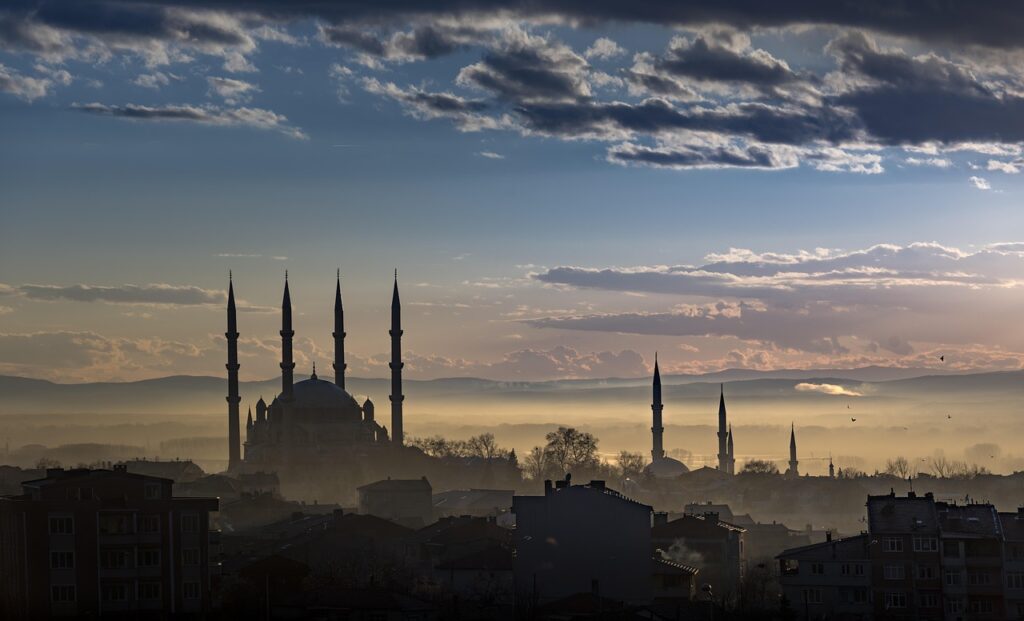
The Selimiye Mosque has dominated Edirne since the year 1575, when the architect Mimar Sinan completed the building he would call his masterpiece. In the four and a half centuries since, the mosque has watched over a city that has been an imperial capital, a border fortress, a battlefield, and a quiet provincial town. Its own history has run through all of it: building, triumph, neglect, war, and restoration. Following the Selimiye through the centuries is following the history of this corner of Turkey, and of the Ottoman tradition that produced it.
The 1560s: A Sultan and His Beloved City
The story begins with Selim II, the son of Suleyman the Magnificent, who loved Edirne with a passion unusual even among the Ottoman sultans. He had served as governor of the city, and he knew its rivers, its hunting grounds, and its climate. When he came to the throne in 1566, he chose Edirne as the site for the great mosque that would bear his name, over the objections of those who expected the new sultan to build in the capital.
The choice was announced early in his reign, and the work was entrusted to Mimar Sinan, the chief imperial architect, who was already in his seventies. The sultan’s mosque was to rise on a hill at the eastern edge of the city, above the meeting of the rivers, visible from every road that led to Edirne. The site was chosen, the plans were drawn, and the greatest building project of the age began.
The Building Years, 1568-1575
Construction of the Selimiye occupied roughly seven years, from about 1568 to 1575. The scale of the work was enormous: the dome alone required thousands of tons of stone, lead, and timber, and the four minarets, each nearly seventy-one meters tall, were engineering feats in themselves. The workforce, drawn from the city and the surrounding countryside, labored season after season under the direction of Sinan’s deputies.
The building was a technical gamble, because no one had ever covered so large a space with a single dome supported only by eight piers. When the great vault was finally closed in 1575, it was a triumph. The mosque was inaugurated with ceremony in the presence of the sultan, and Edirne entered the history of architecture as the site of the Ottoman tradition’s greatest achievement.

The First Century: 1575-1675
In the first century of its life, the Selimiye stood at the center of a thriving city. Edirne was the empire’s staging point for campaigns in the Balkans and Europe, and the mosque’s complex of schools, soup kitchen, and market served a busy population. The arasta, the covered market street built beneath the mosque, traded briskly, and its rents paid for the upkeep of the building as its founder had intended.
The mosque was maintained to a high standard in these years. The Ottoman state kept records of its endowments, and the repairs of the first century were light: a new lamp here, a plaster repair there. The great dome proved its worth, riding out the tremors that shook the region, and the Selimiye entered its second century as solid as the day it was completed.
The 18th Century: Repair and Earthquake
The eighteenth century brought the first serious tests. The region is seismically active, and the earthquakes that periodically shook Thrace damaged the mosque’s plaster, its minarets, and the lead of its dome. The Ottoman court responded with repair campaigns, and the records show repeated work on the building throughout the century, each campaign careful to preserve the original design.
The century also brought the slow decline of the empire, and with it the gradual fading of Edirne’s importance. The city remained a center of trade and a garrison town, but the great age of Ottoman building was over, and the Selimiye stood as a monument to a past that the empire itself was beginning to forget.
The 19th Century: Restoration
The nineteenth century brought a renewed interest in the great monuments of the Ottoman past. As the empire reformed and modernized, its rulers took pride in the achievements of their ancestors, and the Selimiye was restored with care. The dome was re-leaded, the minarets were repaired, and the interior was cleaned and redecorated, returning the mosque to something close to its original brilliance.
This was also the century when the mosque’s reputation reached Europe. Travelers on the road between Istanbul and the Balkans stopped in Edirne, and their accounts spread the fame of the building. By the end of the century, the Selimiye was recognized in the West as one of the wonders of the Ottoman world, and its architect, Sinan, was beginning to be studied by European historians.
The Balkan Wars and 1913
The twentieth century began with the worst period in the mosque’s history. In the Balkan Wars of 1912-1913, Edirne was besieged, starved, and finally occupied, and the city suffered terribly. The Selimiye was damaged in the fighting and the occupation, its surroundings were looted, and the great complex fell into neglect. For a time the fate of the mosque seemed as uncertain as the fate of the empire itself.
The recovery was slow. After the First World War and the establishment of the Turkish Republic, the new state took the monuments of the empire under its care. Repairs were carried out in stages, and the Selimiye was saved. The city, now a quiet border town, began a long process of reconstruction, with the great dome standing over it through every change.

The Republic Years
Under the Turkish Republic, the Selimiye’s fortunes improved steadily. The state assumed responsibility for the mosque as part of the nation’s cultural heritage, and the conservation work of the mid-twentieth century repaired the damage of the war years and beyond. The building was cleaned, the complex was restored, and the mosque returned to its role as the pride of Edirne.
These years also saw the beginning of modern tourism. Travelers from Istanbul began making the journey to see the mosque that the history books described, and the city developed the modest tourist infrastructure that serves it today. By the end of the century, the Selimiye was once again recognized, at home and abroad, as one of the supreme works of Ottoman architecture.
UNESCO Listing and Restoration
In 2011 the Selimiye Mosque and its complex were inscribed on the UNESCO World Heritage List. The inscription brought international attention and a new commitment to conservation, and the years that followed saw careful restoration work on the dome, the minarets, and the surrounding buildings. The mosque entered the twenty-first century in better condition than at almost any time since its completion.
The UNESCO listing also changed the way the building is seen. It is now understood not merely as a monument of Turkey but as a treasure of world civilization, the point at which Ottoman architecture reached its highest expression. The conservation work continues, balancing the demands of worship, tourism, and preservation with a care that the founders of the building would have recognized.

The Mosque in the 21st Century
Today the Selimiye is a working mosque in a living city, as it has been since 1575. The call to prayer still rings from the minarets five times a day, the faithful still gather beneath the great dome, and the arasta below still trades, its restored shops serving locals and visitors alike. The mosque remains what it was designed to be: the heart of Edirne.
For the traveler, the Selimiye offers something increasingly rare: a world masterpiece experienced without crowds, queues, or barriers. You can stand alone beneath the greatest dome of Ottoman architecture, in the building that Sinan called his finest work, and feel four and a half centuries of history around you. The mosque that outlived its empire has entered its fifth century serene and perfect.
The Life of the Complex Through the Ages
The mosque was never alone. Around it, the complex of madrasas, schools, and charitable buildings served the city for centuries, and the arasta market below funded it all. Through the Ottoman centuries the complex functioned as designed, feeding students, teaching the young, and trading in the covered market. The buildings aged with the mosque, repaired and maintained by the endowments that supported them.
The twentieth century scattered the old institutions: the madrasas lost their students as education was modernized, and the buildings were given new uses. The arasta, however, kept trading, and in the twenty-first century it was restored as a working market street. Walking it today, you are inside a system that has been alive for more than four centuries, the economic heart that has kept the masterpiece standing. The continuity is remarkable: the same rhythm of trade and worship that Sinan designed still plays out beneath his dome, across the centuries, unbroken.
Frequently asked questions
Has the Selimiye Mosque ever been damaged?
Yes. Earthquakes damaged the mosque repeatedly in the eighteenth century, and the Balkan Wars of 1912-1913 brought damage and neglect during the siege and occupation of Edirne. In every case the building was repaired, and the dome itself has never collapsed since its completion in 1575.
When did the Selimiye become a UNESCO World Heritage site?
In 2011. The listing recognized the mosque as the finest work of Ottoman architecture and the summit of the tradition, and it brought a new era of conservation to the building and its complex. The mosque remains a functioning place of worship as well as a protected world heritage monument.
Why was the Selimiye built in Edirne rather than Istanbul?
Because Selim II loved Edirne, where he had served as governor before becoming sultan. He chose the old capital as the site for his great mosque, and the hilltop above the rivers was selected for its visibility. The result is that the masterpiece of Ottoman architecture stands in a provincial city rather than in the imperial capital.

All Over Information
The All Over Information editorial team researches and writes practical English-language guides to Turkey. Facts are checked against official and local sources before publication, prices are published as dated ranges rather than quotes, and guides are revised when things change. We accept no sponsored posts, paid placements or paid links.
More guides like this
Visiting Suleymaniye Mosque: Tickets, Hours, and Tips
The Suleymaniye Mosque is the great imperial mosque of the Ottoman golden age, a masterpiece by the architect Mimar Sinan set on…

Best Time to Visit Aspendos Theatre to Avoid Crowds
The theatre of Aspendos is one of the most popular excursion destinations on the Turkish Riviera, and on a busy summer day…

The Architecture of Aspendos Theatre Explained
The theatre of Aspendos is the best-preserved ancient theatre in the world, and its architecture is the reason it has survived so…

Best Time to Visit Mevlana Museum to Avoid Crowds
The Mevlana Museum of Konya is one of the most visited museums of Turkey, and the crowds of the beloved monument can…

Rumeli Fortress Through the Centuries
The Rumeli Fortress — the great castle that commands the narrowest point of the Bosphorus — is one of the most dramatic…
Maiden’s Tower Through the Centuries
The Maiden's Tower has one of the longest and strangest resumes of any building in Turkey: customs post, watchtower, quarantine station, lighthouse,…