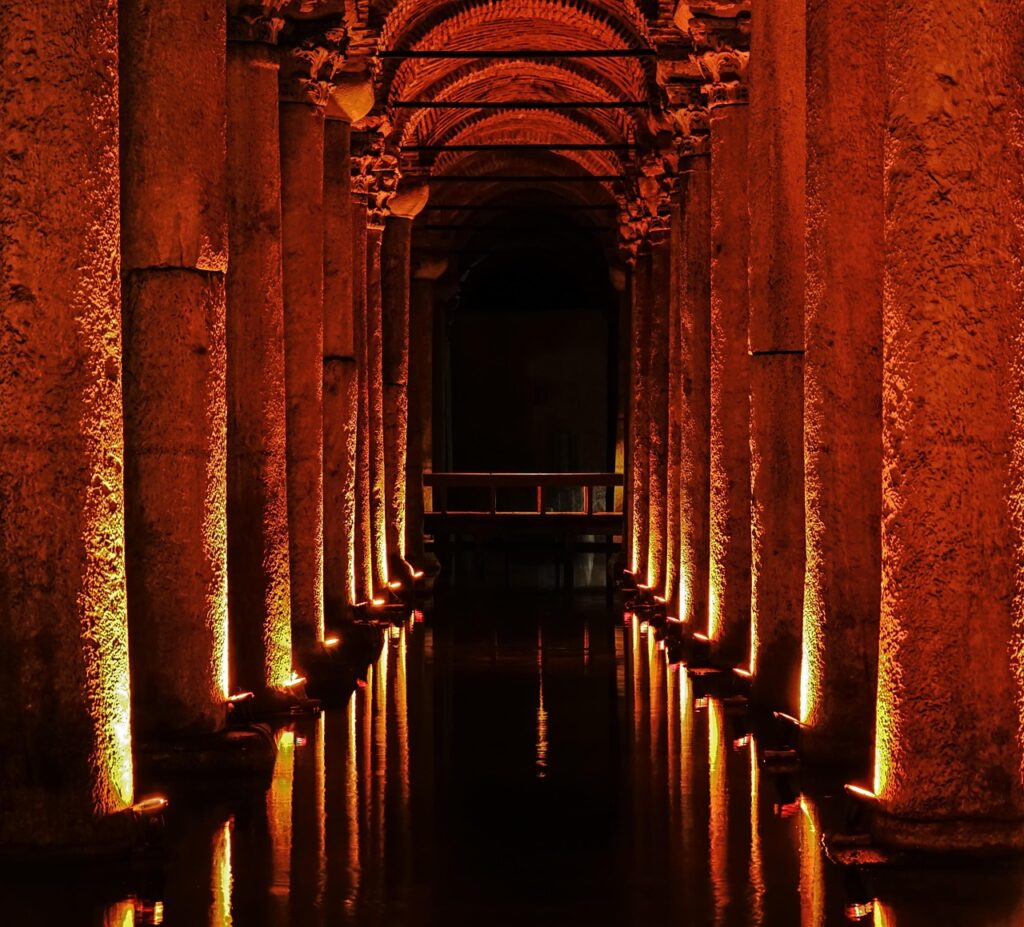
Beneath the busy streets of Sultanahmet lies one of the most extraordinary spaces in Istanbul: the Basilica Cistern, a vast underground reservoir supported by hundreds of columns, built in the sixth century to supply water to the greatest city of the age. Known in Turkish as the Sunken Palace, it was forgotten for centuries, rediscovered by accident, and restored to become one of the most visited monuments in the city. Its history spans nearly fifteen hundred years, from the age of Justinian to the present day, and it is a story of engineering, empire, and rediscovery that every visitor should know before descending into its cool depths.
The Setting: The Heart of Old Constantinople
The Basilica Cistern stands in the historic center of Istanbul, in the district now called Sultanahmet, and its location tells the story of its purpose. In the Byzantine era, this area lay at the heart of Constantinople, close to the imperial palace, the great church of Hagia Sophia, and the city’s most important public buildings.
The cistern takes its name from the basilica that once stood on the site, a great public building of the early city, and the reservoir was built beneath and beyond it to serve the needs of the neighborhood. The choice of site was deliberate: the water was needed where the power of the empire lived.
Today the district is one of the most visited in the world, crowded with the monuments of Byzantium and the Ottoman Empire. Beneath the crowds and the cobblestones, the old cistern still holds its water in the darkness, a secret inheritance of the city above.
532: Justinian and the Great Rebuilding
The founding moment of the Basilica Cistern came in the year 532, in the aftermath of one of the great crises of Byzantine history. That year, the Nika revolt had shaken Constantinople, and the emperor Justinian was rebuilding his capital on a grand scale.
The great church of Hagia Sophia rose from the ashes of the revolt, and the cistern rose with the same ambition. Justinian ordered the construction of a vast underground reservoir to guarantee the water supply of the palace and its district, and the engineering of the cistern matched the ambition of the church.
The cistern was completed within a few years, a triumph of planning and labor. Hundreds of columns were raised in the darkness, the walls were sealed against the earth, and the reservoir filled with the water that would serve the imperial city for centuries.

The Water System of Constantinople
The Basilica Cistern was not a single marvel but the jewel of a vast water system, and its history is bound up with the aqueducts that fed it. Constantinople was built on a peninsula with limited water of its own, and the emperors solved the problem with monumental engineering.
Aqueducts carried water from the countryside into the city, and the great aqueduct of Valens, whose arches still stand in modern Istanbul, was the most famous of the channels that fed the reservoirs. The water arrived in the cisterns to be stored and distributed as the city needed.
The cisterns were the city’s insurance. In a city that could be besieged, a secure water supply was a matter of survival, and the great covered reservoirs, hidden and protected, could keep the city alive through long sieges. The Basilica Cistern was one of the largest and finest of these strongrooms of water.
The Medusa Heads: A Mystery of the Columns
Among the hundreds of columns of the Basilica Cistern, two stand out for a mystery that has fascinated visitors for centuries: the columns set on great stone blocks carved with the head of Medusa, the gorgon of Greek mythology.
The heads are placed strangely. One is set on its side, the other upside down, and no one knows exactly why. The most common explanation is that the stones were reused from an older building and simply placed as they best fitted, but legend has woven its own stories around them.
The legends say the heads were turned to prevent the petrifying gaze of the gorgon from harming the people above, or to represent the conquest of pagan gods by the new faith. Whatever the truth, the Medusa heads remain the most photographed mystery of the cistern.
The Byzantine Centuries: Service and Repair
For most of the Byzantine era, the Basilica Cistern was a working part of the imperial water system, filled, maintained, and drawn upon as the city required. The cistern was kept in repair, its walls were maintained, and its water served the palace and the district above.
The cistern was not the only reservoir of Constantinople; the city was dotted with cisterns of every size, and the Basilica Cistern was among the largest. Its vaults and columns were designed for the long term, and the quality of its construction kept it serviceable for centuries.
The long Byzantine centuries left their mark in repairs and adaptations. The cistern was modified as needs changed, its water was managed as the city’s population rose and fell, and it survived the crises of the empire, a patient presence beneath the changing city.
The Ottoman Era: The Sunken Palace
When the Ottomans conquered Constantinople in 1453, the Basilica Cistern entered a new chapter of its history. The new rulers knew of the cistern, and it was used for a time, but the water system of the Byzantine city was not maintained as it had been, and the great reservoir gradually fell into disuse.
The Ottomans gave the cistern the name it still carries: the Sunken Palace. The vast columned hall, dark and flooded, reminded them of the palaces of legend, and the name captured the imagination of the city, even as the cistern itself was forgotten beneath the streets.
The neighborhood above changed completely. Houses and workshops rose over the old reservoir, the water became stagnant, and the cistern was used for dumping and fishing, its great vaults turned into a strange, hidden underworld known to only a few.

Rediscovery: Petrus Gyllius and the Forgotten Cistern
The great rediscovery came in the sixteenth century, and it happened almost by accident. A scholar named Petrus Gyllius, exploring the antiquities of Constantinople, heard that the houses of the neighborhood were built over water and that fish were drawn up from below.
Investigating, Gyllius found the cistern: a vast columned hall, full of water, hidden beneath the houses. He explored it by boat, measured its columns, and described it to the learned world, and his account brought the Sunken Palace back into the light of history.
The rediscovery was a turning point. Scholars and travelers began to visit the cistern, and it entered the imagination of Europe as one of the wonders of Constantinople. The forgotten reservoir of the Byzantines had found its way back into the story of the city.
The Nineteenth and Twentieth Centuries: From Legend to Museum
For centuries after its rediscovery, the Basilica Cistern lived a strange half-life, known to travelers and scholars but still dark, flooded, and neglected. In the nineteenth century, European visitors described rowing through its black water, their torches illuminating the columns.
The twentieth century brought the beginning of the modern era. In the 1980s, the cistern was cleaned, drained, and opened to the public, its walkways raised above the water and its columns lit from below. The Sunken Palace became a museum, and its fame grew beyond anything its builders imagined.
The restoration of the 1980s was the great transformation. The water was brought to a controlled level, the fish were introduced, and the paths were built, and the cistern began its new life as one of the most magical and popular places in Istanbul.

The Great Restoration of the Twenty-First Century
In the early twenty-first century, the Basilica Cistern underwent its most thorough restoration since the age of Justinian. The great project, completed after years of work, cleaned the columns, repaired the walls, and renewed the building from floor to vault.
The restoration also reimagined the cistern for the modern visitor. The lighting was redesigned, the walkways were rebuilt, and the space was opened to new forms of use, from exhibitions to concerts, while the water and the columns remained the eternal heart of the place.
The restored cistern reopened to a new generation of visitors, and its popularity has never been greater. The dark hall of Justinian, forgotten for centuries and rediscovered by accident, has become one of the essential experiences of Istanbul, and its long story continues.
The Legacy of the Basilica Cistern
The legacy of the Basilica Cistern is written in its survival. Nearly fifteen hundred years after Justinian ordered its construction, it still stands, still holds its water, and still astonishes everyone who descends into it, a monument to the engineering of an empire that vanished long ago.
The cistern is also a lesson in the life of cities. Built for a practical purpose, forgotten when that purpose passed, and reborn as a wonder, it shows how the monuments of the past are constantly reinterpreted by the people who come after, and how a reservoir can become a palace of the imagination.
To stand in the Basilica Cistern is to stand in the presence of all its centuries at once. The columns of Justinian, the legends of the Ottomans, the explorations of the scholars, and the lights of the modern museum all coexist in the water’s reflection, and that continuity is the deepest wonder of the place.
Frequently asked questions
When was the Basilica Cistern built?
The Basilica Cistern was built in the sixth century, in the years after the Nika revolt of 532, under the emperor Justinian. It was part of the great rebuilding of Constantinople that also produced Hagia Sophia.
Why is the Basilica Cistern called the Sunken Palace?
The name comes from the Ottoman era, when the flooded columned hall reminded people of the palaces of legend. The Turkish name, Yerebatan Sarayı, means Sunken Palace, and it has stuck ever since the cistern fell into disuse after the conquest.
What are the Medusa heads in the Basilica Cistern?
The Medusa heads are carved stone blocks, reused from an earlier building, that serve as column bases in two corners of the cistern. One is set sideways and one upside down, and their placement is a mystery that has inspired legends for centuries.

All Over Information
The All Over Information editorial team researches and writes practical English-language guides to Turkey. Facts are checked against official and local sources before publication, prices are published as dated ranges rather than quotes, and guides are revised when things change. We accept no sponsored posts, paid placements or paid links.
More guides like this

Visiting Dolmabahce Palace: Tickets, Hours, and Tips
Planning a visit to Dolmabahce Palace takes a little more thought than most Istanbul sights, because the palace runs on guided tours,…

Visiting Rumeli Fortress: Tickets, Hours, and Tips
The Rumeli Fortress is one of the most impressive sights on the Bosphorus, a vast medieval castle of towers and walls that…

The Complete History of Dolmabahce Palace
Few buildings tell the story of Turkey's last imperial century as completely as Dolmabahce Palace.

Visiting Grand Bazaar: Tickets, Hours, and Tips
The Grand Bazaar is one of the great experiences of Istanbul, and it is also one of the most confusing places for…
The Complete History of Selimiye Mosque
The Selimiye Mosque in Edirne is the crowning achievement of Ottoman architecture, the building that its own creator, Mimar Sinan, called his…

Hagia Sophia Through the Centuries
Hagia Sophia has outlived every empire that built it, and its history is a procession of centuries, each leaving its mark on…