Textiles are the oldest and most personal art of the Turkish people. From the knotted carpets of Anatolia to the silk of Bursa, from flat-weave kilims to embroidered cloth and hand-felted wool, the country’s weaving traditions carry patterns, colors, and techniques that have traveled through centuries. This article introduces the main branches of Turkish textile art, explains what makes each one special, and guides you toward seeing and buying them at their source.
The Ancient Roots of Turkish Textiles
Weaving has been practiced in Anatolia for millennia, and the region was a textile crossroads long before the Turks arrived, standing on the silk routes that connected China to the Mediterranean. The nomadic peoples of Central Asia brought their own traditions, including felt making and knotted pile carpets, and these merged with the skills of the settled Anatolian world. The result is a textile culture of extraordinary depth and variety.
The importance of textiles in Turkish life is hard to overstate. Carpets and kilims covered the floors and walls of homes and tents, wool and cotton clothed the population, and silk dressed the wealthy and the court. Textiles were also wealth itself: dowries were built on woven goods, and the finest carpets were given as gifts between rulers. Understanding this history helps you see the craft markets of today as living continuations of an ancient economy.
Carpet Weaving: The Knotted Pile
The knotted pile carpet is the most famous Turkish textile, and Anatolia has been its heartland for centuries. In pile weaving, short lengths of wool, cotton, or silk are tied around the warp threads and clipped to create a dense, soft surface. The knot count determines the fineness: the more knots per square centimeter, the finer and more valuable the carpet. A skilled weaver produces thousands of knots a day, and a single carpet can take months.
Regional traditions give Turkish carpets their variety. The carpets of central Anatolia, such as those of the Konya plain, use deep reds and blues in bold geometric patterns, while the eastern provinces produce finer, more intricate pieces, and the towns of the Aegean hinterland weave their own distinctive designs. The dyes were traditionally made from roots, leaves, and insects, and the wool came from the local flocks, making each region’s carpets a product of its own landscape.

Kilims: The Flat-Woven Art
Kilims are the flat-woven cousins of the carpet, made by interlocking the colored weft threads so that the pattern appears on both faces. Because they have no pile, they are lighter, thinner, and cheaper than knotted carpets, and they were used for everything from floor coverings to tent walls, saddle bags, and prayer cloths. The kilim’s patterns are often abstract and symbolic, with motifs that weavers have used for generations.
The symbolism of kilim patterns is one of the most fascinating aspects of Turkish textiles. The hook and diamond motifs that represent fertility, the comb, the eye against envy, and the hands-on-hips form that recalls a female figure, all carry meanings understood by the weavers who made them. Kilims are produced across Anatolia, with each region’s colors and patterns identifying its origin. For collectors, they are the most accessible entry into Turkish textile art.
Silk Weaving in Bursa
Bursa, the first capital of the Ottoman state, grew rich on silk, and its connection to the fiber is written into the city’s fabric. Silkworms were raised in the surrounding countryside, the raw silk was traded in the city’s historic silk market, and the weavers produced the luxurious fabrics that dressed the Ottoman court. Even after the silkworm disease of the nineteenth century devastated the industry, Bursa remained the center of Turkish silk.
Today, Bursa’s silk tradition survives in its workshops and shops, where you can see the famous silk towels, scarves, and fabrics, and in the Koza Han, the old silk market where the trade once flourished and which still houses shops and a small museum. Visitors can watch cocoons being unwound into gleaming threads in the city’s silk houses. Bursa silk is a living link to the Ottoman world, and its light, lustrous textiles are among the finest souvenirs in Turkey.

Felt: The Oldest Textile
Felt is the oldest textile in the world, made not by weaving or knitting but by matting wool fibers together with moisture, heat, and pressure, and Turkish felt makers, known as kececiler, have practiced the craft for centuries. The wool is laid out in layers, rolled tightly around a pole, and worked by hand or foot for hours until the fibers lock into a dense, warm fabric. The process is physical, rhythmic, and mesmerizing to watch.
Felt was essential to the nomadic way of life, providing tents, rugs, saddles, and clothing, and it remains a living craft in Anatolia, where makers produce felt hats, vests, slippers, and decorative panels. The central Anatolian town of Afyon is one of the traditional centers, and workshops there still demonstrate the ancient methods. Buying a piece of felt means owning a textile made by a technique that has barely changed for thousands of years.
Embroidery and Needlework
Beyond the loom, Turkish textiles are decorated with the needle. Embroidery traditions vary by region, with each area developing its own stitches, colors, and motifs, from the floral patterns of the Aegean to the geometric work of the southeast. Handkerchiefs, tablecloths, bed linens, and bridal cloths were embroidered by women and passed through families, and the finest pieces are small masterpieces of patience.
The traditional embroidery of the Ottoman world reached a high art in the workshops that served the palace, but the folk tradition is equally rich. Many regional styles are still practiced, and some villages have revived embroidery as a source of income, selling their work through cooperatives. The patterns carry local identity, and buying embroidered textiles from cooperatives supports women’s work and keeps the needle traditions alive in the villages where they were born.
Cotton and the Weaving Towns
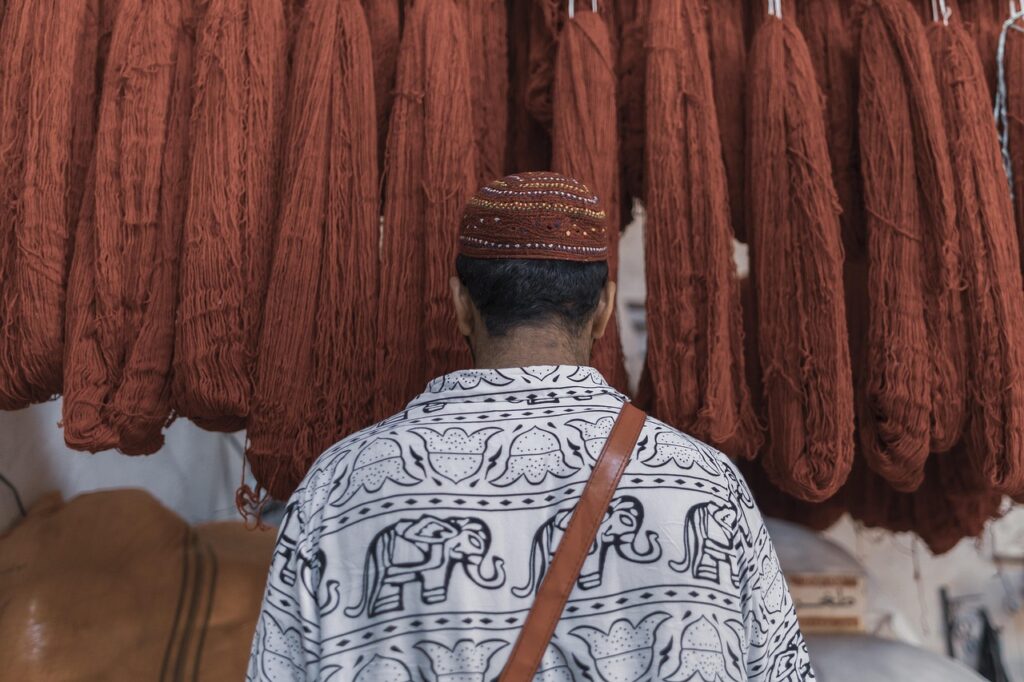
Cotton has been grown in Anatolia for centuries, and the weaving towns of the Aegean and the southeast turned it into the everyday cloth of Turkish life. The towels and bath textiles of the Aegean are famous, woven from local cotton with a softness that comes from long-staple fiber and traditional finishing. The market town of Buldan, in the Aegean hinterland, has been a weaving center for generations, and its workshops still produce the fine cotton cloth that supplies Turkey’s textile shops.
The weaving towns offer the visitor something the big cities cannot: the chance to see looms in action in small family workshops. In Buldan and similar towns, you can watch shuttle looms beating out cloth, buy lengths of cotton by the meter, and understand how a textile economy works at its roots. The fabrics are practical and beautiful, and the prices are among the fairest in the country.
The Weavers Today
Turkish weaving faces the same pressures as crafts everywhere: cheap machine-made imitations, the decline of traditional skills, and the pull of urban jobs on the young. Yet the craft is far from dying. Carpet and kilim weaving continues across Anatolia, supported by cooperatives and export demand, and a younger generation of designers is reviving old techniques with contemporary aesthetics, finding new markets at home and abroad.
The cooperatives are the quiet heroes of the story. In villages from the Aegean to the southeast, weaving cooperatives organize production, pay fair wages, and market the work of women who might otherwise have no income, and many welcome visitors to watch and buy. For travelers, the choice is clear: machine-made imitations will always be cheaper, but the living craft, made by hand in a workshop or village you can visit, is what the textile tradition is actually about.

Visiting Weaving Centers and Buying Textiles
To experience Turkish textiles at their best, go to the sources. Visit the carpet-weaving villages of central Anatolia, the kilim cooperatives of the southeast, the silk houses of Bursa, the felt workshops of Afyon, and the cotton mills of Buldan. In each place, you can watch the making, ask questions, and buy directly from the makers, which is both the most authentic and the fairest way to purchase.
When you buy, use your eyes and hands. Examine the back of carpets and kilims for even, honest construction, feel the weight and softness of wool and cotton, and check that embroidery and felt are genuinely hand-worked. Ask about dyes and materials, and be wary of prices that seem too good for hand labor. A textile bought from its maker carries a story, and in Turkey, that story is part of the pattern itself.
Caring for Your Turkish Textiles
A handwoven carpet or kilim is an heirloom, and caring for it properly keeps it beautiful for generations. Regular vacuuming removes the grit that wears at the fibers, and occasional rotation evens out fading from sunlight. Professional cleaning, rather than machine washing, is the safe choice for pile carpets, though flat-weave kilims and cotton textiles are more forgiving.
Moisture is the enemy of wool. Carpets and kilims should be kept dry and aired regularly, and in humid climates a breathable underlay protects them from the floor. Silk pieces, rare and delicate, deserve the lightest touch, while felt and embroidery benefit from protection from moths. Most sellers include care instructions with their pieces, and following them is the simplest way to honor the work of the weaver.
Turkish textiles were made to be lived with, and the pieces that are used and loved, rather than sealed away, keep the tradition alive in homes far from the looms that made them.
Frequently asked questions
What is the difference between a carpet and a kilim?
A carpet has a knotted pile, created by tying short lengths of yarn around the warp threads and clipping them, which produces a soft, raised surface. A kilim is flat-woven, with the colored threads interlocked to form the pattern on both faces. Carpets are generally thicker, warmer, and more expensive, while kilims are lighter and were traditionally used as floor coverings, wall hangings, and saddle bags.
Where can I see traditional Turkish weaving?
The best places are the sources themselves: carpet-weaving villages of central Anatolia, kilim cooperatives in the southeast, the silk workshops of Bursa, felt makers in Afyon, and the cotton-weaving town of Buldan. Many workshops and cooperatives welcome visitors, demonstrating their techniques and selling directly. Istanbul‘s Grand Bazaar and the craft museums also display fine examples of every branch of Turkish textile art.
How can I tell a handmade carpet from a machine-made one?
Examine the back of the carpet, where the structure of the knots is visible. Handmade carpets show irregular, individual knots, while machine-made carpets have a perfectly uniform, often visible grid. The edges and fringes of handwoven pieces show subtle irregularities, and the pattern may not be perfectly symmetrical. Asking the seller to demonstrate the construction and to explain the carpet’s origin is also a reliable test of authenticity.

All Over Information
The All Over Information editorial team researches and writes practical English-language guides to Turkey. Facts are checked against official and local sources before publication, prices are published as dated ranges rather than quotes, and guides are revised when things change. We accept no sponsored posts, paid placements or paid links.
More guides like this

Turkish Wedding Traditions Explained for Foreigners
If you spend any time in Turkey, you will probably be invited to a wedding. Turkish weddings are the great celebrations of…

Understanding Turkish Football Fan Culture
Football in Turkey is not a pastime; it is a passion that runs through the whole society.
Understanding Turkish Naming Traditions
Every culture has its own way of naming children, and Turkey's is one of the most expressive in the world. A Turkish…

A Deep Dive into Rumi’s Legacy in Turkey
Rumi's legacy in Turkey is one of the most remarkable survival stories in the history of religion and culture.
Understanding Ebru Marbling Art
Ebru is the Turkish art of marbling: painting on the surface of water, then transferring the image to paper.

Turkish Coffee Fortune Telling: How the Tradition Actually Works
Turkish coffee fortune telling, known locally as kahve falı, is one of the most recognizable social rituals connected to Turkish coffee culture.