Turkish coffee stands apart from every other way of making coffee, and the differences go far beyond taste. From the powder-fine grind to the unfiltered cup, from the foam to the fortune telling, the Turkish method is a complete philosophy of how coffee should be brewed and drunk. Comparing it with espresso, French press, Greek coffee, and the other great traditions shows exactly what makes the Turkish cup unique, and why it has survived five centuries of competition without changing its essential character.
The fineness also affects how the coffee is bought and stored: Turkish coffee is sold ready-ground, because home grinding to that level is difficult, and the package is opened and used quickly. Freshness is essential at this fineness, and the best cups come from packages that have not sat long on the shelf.
The Grind: Powder vs. Coarse
The Turkish grind is the finest in the coffee world, ground to a powder finer than espresso and closer in texture to flour or cocoa. Nothing is filtered, so every particle of the bean ends up in the cup.
Espresso is ground fine but still granular, and the French press demands a coarse grind, because its metal mesh would let fine powder through. Each method’s grind is dictated by its equipment and its goal.
The powder-fine grind of Turkish coffee is what gives the drink its body and its sediment. It is also why the coffee must be brewed gently: powder this fine would turn bitter in seconds under aggressive heat.
The repeated rise and settle is the Turkish brewer’s signature move, and it is what builds the dense foam. A cook who lets the pot rise once produces a flat cup; a cook who coaxes it up two or three times earns the praise of the table.
The Brew: Simmered vs. Pressed
Turkish coffee is simmered, not brewed. The cold water, powder, and sugar heat together in a small pot, and the mixture rises to the edge of the pot two or three times before being poured.
Espresso forces hot water through a compact bed of coffee under high pressure, producing a concentrated shot in seconds. The French press steeps coarse grounds in hot water and presses them out, and the filter brewer lets water drip through a paper bed.
The Turkish simmer extracts flavor slowly and gently, building the foam as it goes. It is the only major method in which the coffee is actually boiled, or nearly boiled, in the serving pot.
The unfiltered method also makes the cup last longer: the grounds keep the liquid dark and the flavor concentrated right to the bottom. For this reason the Turkish cup can be sipped slowly, while a filtered coffee goes dull as it cools.

The Filter: None vs. All
Turkish coffee is served unfiltered, grounds and all. The drinker sips the liquid and leaves the muddy sediment at the bottom of the cup, a fact that shapes the whole ritual.
Espresso is filtered by the machine, the French press by its mesh, and drip coffee by paper, so the cups come clear. Only Turkish coffee, Greek coffee, and a few close relatives ask the drinker to contend with the grounds.
This lack of a filter is the source of the Turkish ritual: the careful sipping, the settling time, and finally the upturned cup and the fortune telling. The grounds are not a flaw; they are the feature.
The foam also carries the aromatic oils that would otherwise rise to the surface and vanish, so the first sip of Turkish coffee is the most fragrant moment of the cup. Experienced drinkers taste the foam first, before the liquid, and judge the whole cup by it.
The Foam: The Mark of Skill
The foam, the köpük, is the pride of the Turkish cup, a dense golden layer that forms as the coffee rises and settles during the brew. Without it, the cup is judged a failure.
Espresso has its crema, a thin layer of oils produced by pressure, but it behaves differently and disappears quickly. The Turkish foam is thicker, longer-lasting, and created by patience rather than machinery.
The foam is divided among the cups first, before the liquid, so every drinker gets a share. A cup served with a good layer of foam on top is the sign of a brewer who knows the craft.
This brewing rule has a social side too: the host must ask each guest for their sweetness level before the pot goes on the flame, and the question itself is part of the hospitality. The order of the day, sade, az, orta, çok, is one of the first phrases any visitor to Turkey learns.
The Sugar: In the Pot, Not the Cup
Turkish coffee is sweetened during the brew, with sugar added to the cold water at the start, never after the cup is poured. The sweetness is ordered in advance, from sade to çok şekerli.
Espresso is sweetened in the cup, if at all, and most coffee traditions add sugar at the table. The French press and filter coffee are almost always sweetened to taste after brewing.
Brewing the sugar in changes the result: every sip is evenly sweet, and the sugar helps build the foam. The Turkish rule is the only major tradition in which sweetness is a brewing decision, not a table decision.
The saucer matters as much as the cup: it catches nothing in particular but completes the frame, and the glass of water and the sweet sit beside it. The whole arrangement, cup, saucer, water, sweet, is a still life that appears at every table where the tradition is honored.
The Cup: Small and Handleless
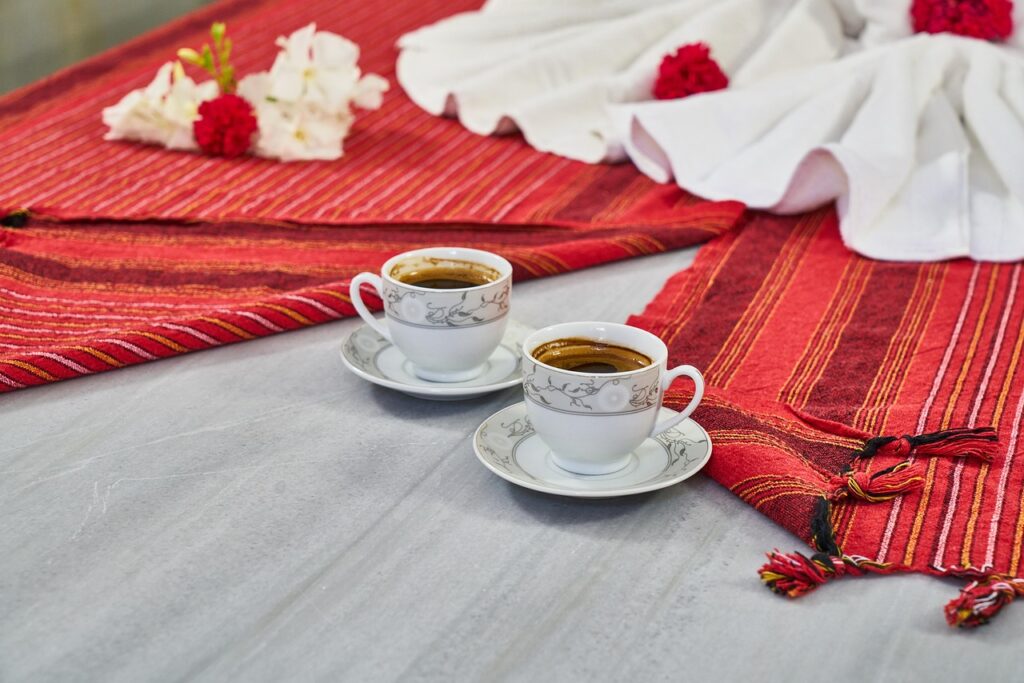
Turkish coffee is served in a small cup, about the size of an espresso cup, without a handle, sitting on a saucer with a glass of water beside it. The cup is part of the ritual.
Espresso uses a similar small cup with a handle, and the latte and cappuccino have built their own glass and ceramic traditions. The Turkish cup is distinctive for its shape and its complete lack of handles.
The small cup keeps the coffee strong and hot, and the handleless design makes the drinker cradle the cup, a gesture that is part of the ceremony. The cup is so iconic that it is sold worldwide as a symbol of the drink.
The order of the water and the coffee carries its own meaning. Tradition says the guest who drinks the water first is thirsty, while the one who reaches for the coffee first came for conversation. Either way, the ritual of the trio is a small piece of theater that plays out across the country every day.

The Company: Water and Lokum
The Turkish cup never arrives alone. A glass of cold water comes first, to cleanse the palate, and a piece of lokum, Turkish delight, or a small chocolate sits on the saucer.
Espresso is often served with a spoon and sometimes a biscuit, but the water-and-sweet pairing is uniquely Turkish. The combination of water, bitter coffee, and sweetness is a deliberate sequence of tastes.
The water is drunk first, the coffee sipped slowly, and the sweet taken at the end, or sometimes between sips. The trio turns a quick drink into a small ceremony with a beginning, a middle, and an end.
The Pace: Slow vs. Fast
Turkish coffee is a slow drink by design. The brewing takes several minutes, the drinking takes longer, and the ritual expects conversation around the cup.
Espresso is engineered for speed, a shot consumed in seconds at a counter. Filter coffee and French press are more leisurely but still take their flavor as a single serving.
The Turkish pace is not an accident; it is the point. The coffee is the frame for talk, and the tradition assumes that a cup of coffee and an hour of conversation belong together.
The shared heritage means that travelers can order the same cup under different names across the eastern Mediterranean. The pot, the grind, and the technique cross borders easily, but the Turkish ritual, with its sweetness levels and its fortune telling, gives the cup a character that the relatives do not quite share.
Greek and Arabic Coffee: Close Relatives
The closest relatives of Turkish coffee are Greek coffee and Arabic coffee, which use the same pot, the same fine grind, and the same simmering method. The techniques are nearly identical, and the difference is largely a matter of naming and local habits.
Greek coffee is the Turkish method under a different name, a legacy of the region’s shared Ottoman history. Arabic coffee, especially in the Gulf, adds cardamom and sometimes saffron, and the serving ritual differs.
What separates the Turkish version is the culture around it: the vocabulary of sweetness, the fortune telling, and the coffeehouse tradition. The method is shared, but the Turkish wrapper is its own.
What Makes It Undeniably Turkish
The method, the foam, the sugar, the cup, the water, the sweet, and the fortune telling together form a package that no other tradition exactly matches. Any one element exists elsewhere, but the combination is Turkish.
The Turkish style also carries its history: a five-hundred-year-old method that never needed to change, wrapped in a social ritual that UNESCO recognized as world heritage. That continuity is the deepest difference of all.
When you drink Turkish coffee, you are not just tasting a brew; you are stepping into a tradition that has shaped the culture around it for centuries. That is what makes the cup Turkish, and no comparison with any other method changes it.
Frequently asked questions
What is the difference between Turkish coffee and espresso?
Turkish coffee is simmered unfiltered from powder-fine grounds in a cezve and served with the sediment in the cup, while espresso is brewed under pressure through a machine and served clear. Turkish coffee is sweetened during brewing and topped with a thick foam, whereas espresso is a fast, concentrated shot. The two share little beyond being strong and served in small cups.
Is Greek coffee the same as Turkish coffee?
Greek coffee uses the same method, the same fine grind, and the same small pot, because both traditions share Ottoman roots. The practical difference is mainly the name and some local habits. Arabic coffee, by contrast, often adds cardamom and follows a different serving ritual. The Turkish version is distinguished by its sweetness vocabulary, fortune telling, and coffeehouse culture.
Why is Turkish coffee so thick and strong?
Turkish coffee is thick because the grounds are ground to a powder and never filtered, so the body of the bean remains in the cup. It is strong because a high proportion of coffee to water is simmered slowly, extracting full flavor. The drinker sips the liquid and leaves the sediment behind. The strength and body are deliberate, part of a tradition designed for slow, social drinking.

All Over Information
The All Over Information editorial team researches and writes practical English-language guides to Turkey. Facts are checked against official and local sources before publication, prices are published as dated ranges rather than quotes, and guides are revised when things change. We accept no sponsored posts, paid placements or paid links.
More guides like this

Where to Find the Best Turkish Flatbread (Bazlama) in Turkey
Bazlama is everywhere in Turkey, but the best examples are found where the tradition runs deepest: in villages, at roadside breakfast stops,…

Stuffed Grape Leaves (Dolma): A Taste of Turkish Culture
Some dishes are meals, and some are conversations, and dolma belongs to the second kind.

How to Make Authentic Kunefe at Home
Kunefe looks like a dessert only a professional could make, but the truth is friendlier: it takes four ingredients, one pan, and…

Turkish Simit Sandwiches Vs. International Variations: What Makes It Turkish
Every great bread culture has its ring, its roll, or its crust that gets split and filled, from the New York bagel…

Turkey’s Best Food Tours
Turkey is one of the world's great food destinations, and there is no better way to explore its flavors than on a…

Iskender Kebab Vs. International Variations: What Makes It Turkish
Turkish restaurants around the world serve dishes that look like relatives of Iskender kebab: shawarma wraps in the Middle East, gyros in…