Pergamon lived for more than two thousand years, and its centuries are written across the hill above Bergama and the plain below. From an obscure Aeolian town it rose to the capital of a Hellenistic kingdom, became the first capital of the Roman province of Asia, housed the greatest physician of antiquity, and survived as a Christian fortress into the Turkish age. This guide follows Pergamon century by century, so that when you climb the acropolis or walk the Asclepieion, you know which age each terrace and temple belongs to.
Before the Attalids: The Aeolian City
The hill of Pergamon was settled long before the kings made it famous. The region of Mysia, in northwestern Anatolia, was occupied from early times, and Greek colonists, chiefly Aeolians, established towns along the coast and the valleys.
The settlement on the acropolis hill was a fortress and a small town, its inhabitants farming the Caicus plain and trading with the wider Greek world. The name Pergamon, sometimes written Pergamum, was ancient, and the city appears in the legends of the region, associated with the hero Telephus.
For centuries Pergamon was a modest place, one fortress among many. Nothing in its early history hinted at the empire that would one day rule from its summit.
Philetaerus and the Birth of a Kingdom
The turning point came after the death of Alexander the Great in 323 BC, when his generals fought for his empire. Lysimachos, who controlled the region, entrusted his treasury, a fortune in silver, to a trusted officer named Philetaerus, who held it in the fortress of Pergamon.
In 282 BC, Philetaerus turned against his master, seized the treasury, and declared Pergamon independent. He ruled for nearly twenty years, built the city’s walls, and founded the dynasty, though he never took the title of king, styling himself simply the master of the fortress.
His nephew Eumenes I succeeded him, and then Attalus I, the first to take the royal title. In a few decades, the fortress of a treasurer had become the capital of a state.

Attalus I and the Victory Over the Gauls
The early kingdom faced its greatest threat from the Gauls, Celtic peoples who had invaded Anatolia and terrorized the Greek cities, exacting tribute and plundering at will. Around 230 BC, Attalus I marched against them and won a decisive victory.
The triumph was celebrated across the Greek world, and Attalus took the title of king. He commemorated the war with the famous sculptures of dying Gauls, works of such power that they were copied by the Romans and survive today in marble versions.
The victory gave Pergamon prestige, confidence, and an alliance with Rome, which saw in the Attalids useful friends against the Seleucid kings. From this moment, Pergamon was a power to be reckoned with.
Eumenes II: The Golden Age
The golden age of Pergamon came under Eumenes II, who ruled from 197 to 159 BC. Allied with Rome, he defeated the Seleucid king Antiochus III, and the peace that followed gave Pergamon control of much of western Asia Minor.
Eumenes transformed the acropolis into one of the great urban centers of antiquity. He built the theatre, the library, the gymnasium, the palaces, and the Great Altar of Zeus, and he filled the city with the sculpture and the scholars that made it the rival of Alexandria.
Under Eumenes, Pergamon was the cultural capital of the Greek world’s new order, a kingdom whose art and architecture set the style for the age. The city on the hill became the model of what a Hellenistic capital should be.

The Last Attalids and the Bequest to Rome
Eumenes’s brother Attalus II continued the work, building the stoa in Athens that still bears his name and extending the city’s monuments. His nephew Attalus III, the last king, ruled only a few years.
Attalus III died in 133 BC without an heir, and in his will he bequeathed the kingdom to Rome. The bequest, the largest single territory ever passed to the republic without a war, made Rome the master of western Asia Minor.
Pergamon itself was made the first capital of the new province of Asia, and the age of the kings ended. The city that had never been conquered was now part of the greatest empire the Mediterranean had seen.
The Roman Provincial Capital
Under Rome, Pergamon entered a new age of prosperity. As the capital of the province of Asia, it was the seat of the Roman governor and the first city of the province, before the honor passed to Ephesus in the decades that followed.
The Romans built on and around the acropolis: new baths, a stadium in the plain, a theatre, and temples, including the great Trajaneum that crowned the summit in honor of the emperor Trajan. The city remained one of the richest and most respected in the province.
The Roman centuries also brought the greatest of Pergamon’s citizens, the physician Galen, born here in 129 AD, who studied at the Asclepieion and carried the city’s fame across the empire.
The Asclepieion’s Imperial Century
The healing sanctuary of Asclepius became, in the Roman period, one of the most famous medical centers of the ancient world. Emperors and ordinary patients alike came to Pergamon to sleep in the incubation hall and await the god’s healing dreams.
The sanctuary was rebuilt and enlarged in the second century AD with a colonnaded entrance, new treatment halls, baths, a theatre, and a library, and its physicians practiced a sophisticated combination of therapy, diet, and faith. It was the Mayo Clinic of the ancient world.
The Asclepieion’s fame peaked in the time of Galen and the Antonine emperors, and it remained active for centuries. Its ruins, green and peaceful, still convey the healing atmosphere that made it famous.
Between the Roman centuries and the Christian age, Pergamon also witnessed the quieter dramas of imperial life. It was the city where the physician Galen performed public anatomical demonstrations, where the proconsuls of Asia held court, and where the cult of the emperors found some of its most lavish temples. The remains of these centuries, the baths, the stadium, the great brick temple of the Egyptian gods in the lower city, show a city that had traded the drama of kings for the solid comforts of empire.
The Christian City and the Seven Churches
Pergamon appears in the Book of Revelation as one of the seven churches of Asia, addressed with the striking phrase about the throne of Satan, which scholars connect to the great altar and the imperial cult of the city.
The Christian community of Pergamon survived and grew, and the city remained an important see of the eastern church through the Byzantine centuries. The old pagan temples were abandoned or transformed, and the city on the hill became a fortress of the Byzantine state.
The Byzantine city rebuilt the acropolis walls, and the summit was crowned by Christian churches and the barracks of the garrison. The centuries of the kings and the emperors had given way to the long age of the Christian empire.

The Byzantine Twilight and Turkish Bergama
In the later Byzantine centuries, Pergamon was a frontier fortress, changing hands between the Byzantines and their Turkish neighbors. In the early fourteenth century, the region passed definitively to the Turks, and the hilltop city was gradually abandoned for the town below.
The new Turkish town, Bergama, grew in the plain, using the ancient buildings as quarries and the Red Basilica as a church and then a mosque. The acropolis, stripped and roofless, became a ruin above the living town.
For centuries, Bergama prospered as a market town, its bazaar and its crafts, especially carpets and leather, known across the region. The ancient city slept on the hill while the modern one lived at its feet.
The Ottoman town that grew at the foot of the acropolis was never allowed to forget its ancient neighbor entirely. European travelers of the seventeenth and eighteenth centuries described the ruins on the hill, and the name of Pergamon was kept alive in the books of scholars long before the first spade was lifted. When the German excavations began in the 1870s, they found a site that had been known, described, and wondered at for two hundred years, and the town of Bergama had already built its identity around the hill.
Excavation, Museums, and the Modern Age
The modern history of Pergamon began in the nineteenth century, when European travelers identified the site and German archaeologists started to dig. The excavation of the Great Altar, the theatre, and the acropolis, from the 1870s onward, made Pergamon famous across Europe.
The German teams transported the altar and much of the sculpture to Berlin, where the Pergamon Museum was built to display them, and the excavation of the site has continued, with interruptions, ever since. The Asclepieion, the Red Basilica, and the lower city have all been studied and restored.
In 2014, UNESCO inscribed Pergamon on the World Heritage List, and today the acropolis, the sanctuary, and the town together tell the story of two thousand years. The city that began as a fortress has become, once again, one of the great places of the ancient world, visited by the world it once ruled.
Frequently asked questions
What was the golden age of Pergamon?
The reign of Eumenes II, from 197 to 159 BC, was the city’s golden age. He defeated the Seleucids, extended the kingdom across western Asia Minor, and built the theatre, the library, the gymnasium, and the Great Altar of Zeus, making Pergamon the cultural capital of the Hellenistic world.
When did Pergamon become Roman?
In 133 BC, when the last Attalid king, Attalus III, bequeathed his kingdom to Rome in his will. Pergamon became the first capital of the province of Asia, and the Romans continued the city’s building tradition with baths, a stadium, and the Trajaneum on the summit.
Who was the most famous citizen of Pergamon?
The physician Galen, born in Pergamon in 129 AD, who trained at the Asclepieion and became the most influential doctor of antiquity. His writings dominated medicine for more than a thousand years, and he served as physician to Roman emperors.

All Over Information
The All Over Information editorial team researches and writes practical English-language guides to Turkey. Facts are checked against official and local sources before publication, prices are published as dated ranges rather than quotes, and guides are revised when things change. We accept no sponsored posts, paid placements or paid links.
More guides like this

Why Xanthos Should Be on Your Turkey Bucket List
Turkey's southwest coast is full of ancient wonders, but Xanthos stands apart. It is not the biggest site or the best preserved,…

The Complete History of Zeugma Mosaic Museum
The Zeugma Mosaic Museum in Gaziantep is one of the great museums of the ancient world, but its story is as dramatic…
Why Pergamon Should Be on Your Turkey Bucket List
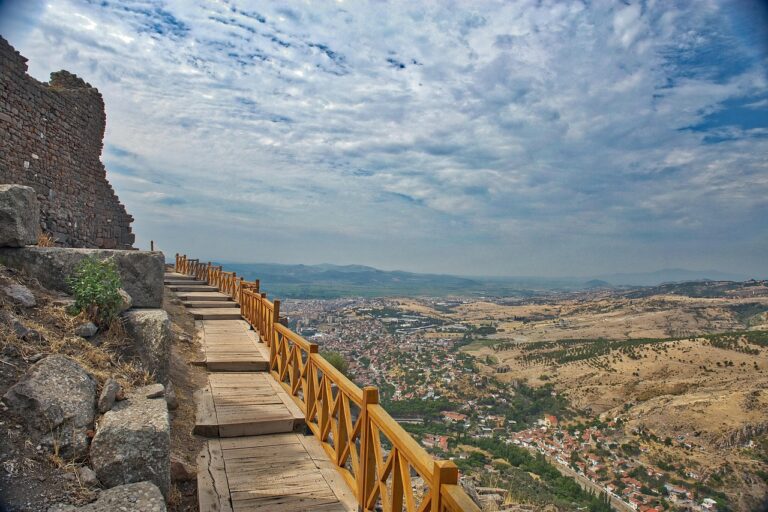
Every traveler to Turkey knows Ephesus, and far fewer know Pergamon, which is precisely why it deserves a place on your list.

Best Time to Visit Aspendos to Avoid Crowds
Aspendos is one of the most visited sites on the Turkish coast, and its theatre can feel like a busy public square…

The Complete History of Termessos
Termessos is one of the most extraordinary ancient cities in the world: a Pisidian mountain city built high in the Taurus range…
The Architecture of Aphrodisias Explained
Aphrodisias is the rare ancient city you can read like a textbook, because almost all of it was built from the same…