Aphrodisias, in the Aydin province of southwestern Turkey, is the city of the goddess Aphrodite and one of the best-preserved ancient cities of the Mediterranean. It was a place of temples and theatres, of the finest sculpture workshops in the Roman world, and of one of the greatest stadiums of antiquity, and it survived, buried and forgotten, until modern archaeology brought it back to light. This article traces the complete history of Aphrodisias, from its ancient sanctuary to its UNESCO inscription in 2017, so that you can read its stones with the story in mind.
The Beginnings: A Sanctuary in the Valley
The history of Aphrodisias begins long before the city took the name of the goddess. The site, in the fertile valley of the Maeander region, near the modern village of Geyre, was occupied from early times, and a sanctuary stood here from at least the early first millennium BC.
The cult that grew at the site was ancient and local, a goddess of the earth and of fertility whose identity would later merge with the Greek Aphrodite. The sanctuary attracted worshippers from the surrounding region, and the settlement around it grew slowly.
The strategic position helped: the site lay at a crossroads of the roads connecting the Aegean coast to the interior, and it controlled a rich agricultural plain. The sanctuary was the seed, and the city that grew around it would become one of the great centers of the ancient world.
The City of Aphrodite Takes Shape
In the Hellenistic period, following the conquests of Alexander the Great, the settlement around the sanctuary grew into a proper city, and the cult of Aphrodite became its defining institution. The city took the name Aphrodisias, the city of Aphrodite.
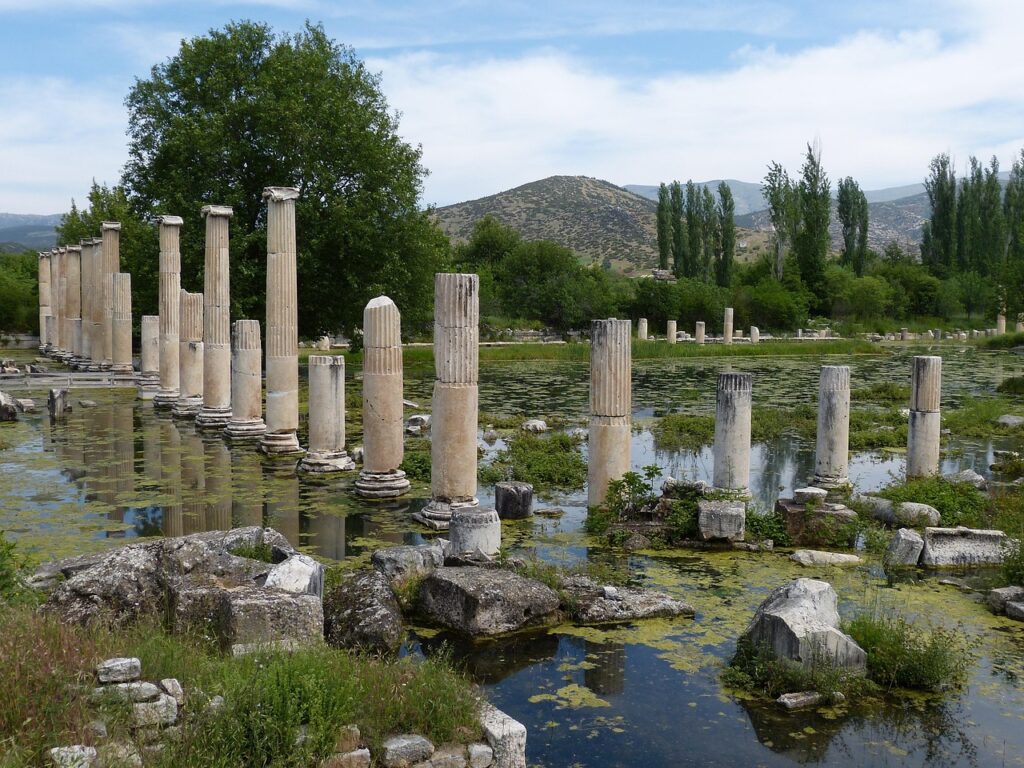
The great temple of the goddess was built in the first century BC, a handsome building of the Ionic order standing within a colonnaded precinct. It was the heart of the city, the source of its identity, and the center of a cult that drew pilgrims from across the region.
The city’s patron goddess brought it political favors as well as worshippers. In the Roman period, Aphrodisias cultivated close ties with Rome, and the city grew rich on the privileges and protection that its loyalty earned it.
The Roman City: Sculpture and Stone
Under the Roman empire, Aphrodisias entered its golden age. The city was rebuilt and adorned with the full apparatus of a prosperous Roman town: a theatre, an odeon, baths, agoras, a bouleuterion, and monumental gates.
The source of the city’s wealth and fame was its marble and its sculptors. The quarries of the region produced fine white and colored marble, and the sculptors of Aphrodisias became the most celebrated in the ancient world, exporting their statues across the empire.
The city’s workshops turned out portrait busts, mythological figures, and decorative reliefs of astonishing quality, and the Aphrodisian style, smooth, refined, and expressive, was admired from Rome to the eastern provinces. The city was, in effect, the marble workshop of the Roman world.
The Sebasteion: The Empire in Marble
The most remarkable monument of Roman Aphrodisias is the Sebasteion, the sanctuary of the imperial cult, built in the first century AD with the support of local benefactors. It was a grand complex dedicated to the emperors and to the goddess Aphrodite, who was claimed as the ancestor of the Roman people.
The Sebasteion took the form of a long processional courtyard, lined on three sides by three-storey buildings decorated with sculpted relief panels. The panels depicted the emperors, the gods, and scenes from mythology, and they formed one of the most elaborate cycles of sculpture in the Roman world.
Many of the reliefs survived, buried and intact, and they are now displayed in the Aphrodisias Museum. The Sebasteion is the clearest statement of the city’s bond with Rome, and its sculpture is among the finest to survive from antiquity.

The Stadium: The City of Spectacle
The stadium of Aphrodisias is one of the best-preserved monuments of its kind in the ancient world, and it is the great surprise of the site. Built in the first century AD, it is a vast oval of seating, some two hundred and seventy meters long, capable of holding around thirty thousand spectators.
The seating, cut from the natural hillside and completed in masonry, survives almost completely, and you can walk the entire circuit, from the curved ends to the long sides, as the crowds once did. It was used for athletic contests and, in the Roman manner, for gladiatorial shows.
The stadium is a monument of pure scale, and its preservation gives a sense of the city’s population and its love of spectacle. Standing at the center of the arena, you can hear the roar of thirty thousand voices across two thousand years.
One detail that visitors often miss is the beauty of the city’s setting. Aphrodisias stands in a quiet valley of olive groves and fields, at the foot of the mountains that supplied its marble, and the quarries themselves, with their half-cut blocks, are part of the site’s story. The peace of the landscape matches the peace of the ruins: no busy coast, no port, no crowds, only the marble city and the land that raised it. That serenity is part of what makes a visit to Aphrodisias feel like a discovery.
The Sculpture Workshops
The sculpture workshops of Aphrodisias were the city’s most famous export, and archaeology has found their remains: the courtyards, the storerooms, and the unfinished statues that show how the masters worked. The city produced the finest marble sculpture of the Roman world.
The Aphrodisian sculptors worked in a distinctive style, with smooth, polished surfaces, careful anatomy, and expressive faces, and their works have been found across the empire, from Italy to the eastern provinces. The great statue of Aphrodite of Aphrodisias, with her many forms, was copied throughout the ancient world.
The discovery of the workshops and their products transformed the understanding of ancient art, and the museum at the site displays a collection that is the envy of the world’s great museums. The sculptors of Aphrodisias made the city immortal in marble.

The Temple Becomes a Church
In late antiquity, the fortunes of Aphrodisias changed with the conversion of the empire to Christianity. The city was renamed, in honor of the province, and the great temple of Aphrodite was transformed in the fifth century into a Christian basilica.
The conversion was a profound act: the columns and the walls of the pagan temple were incorporated into the new church, and the cult of the goddess was replaced by the worship of Christ. The building, one of the largest churches of its region, stood at the heart of the Christian city.
The city remained important in the Byzantine period, but the old world was fading. The earthquakes that had always shaken the region took their toll, and the city’s population slowly declined, though its marble buildings continued to be quarried and reused.
Decline and the Buried City
The decline of Aphrodisias was a long process. The earthquakes of late antiquity and the medieval period brought down the great buildings, and the city shrank until only a small settlement, the village of Geyre, occupied the ground above the ruins.
The marble of the ancient city was carried away for building across the region, and the remaining ruins were buried under the silt of the valley and the debris of centuries. The name of Aphrodisias faded from memory, and the site became fields and village land.
When travelers of the eighteenth and nineteenth centuries passed through, some noted the ancient remains, but the identity of the buried city was uncertain. It would take a determined archaeologist to give the city back its name.

Kenan Erim and the Rediscovery
The man who brought Aphrodisias back to the world was Kenan Erim, a Turkish archaeologist of New York University, who began excavating the site in 1961 and continued for thirty years. His work uncovered the theatre, the stadium, the Sebasteion, and the sculpture that made the site famous.
Erim also built the Aphrodisias Museum, established beside the site, to house the extraordinary finds, and he devoted his life to the city, even asking to be buried there. His tomb stands beside the museum today.
The excavations revealed a city of remarkable completeness, and the work has continued since Erim’s death in 1990 under an international team. The rediscovery of Aphrodisias is one of the great success stories of modern archaeology.
UNESCO and Aphrodisias Today
In 2017, UNESCO inscribed Aphrodisias on the World Heritage List, recognizing the city’s exceptional architecture, its sculpture, and its place in the history of art. The inscription covers the ancient city and the quarries that supplied its marble.
Today the site is one of the most complete ancient cities in Turkey, with its theatre, stadium, Sebasteion, temple, and agora standing in a setting of fields and olive trees. The museum, with its sculpture galleries, is among the finest in the country.
Aphrodisias offers the traveler something that even Ephesus cannot: the sense of a city that has been spared the crowds, a place where the sculpture is still on the site, and where the goddess’s name still hangs in the air. Two thousand years of history are waiting among the marble.
Frequently asked questions
Who discovered Aphrodisias?
The modern excavation of Aphrodisias was begun in 1961 by Kenan Erim, a Turkish archaeologist working for New York University, who continued for thirty years and also built the site museum. Since his death in 1990, an international team has continued the work, and UNESCO inscribed the site in 2017.
Why was Aphrodisias famous?
It was the city of Aphrodite and the home of the finest sculpture workshops of the Roman world. Its sculptors exported statues across the empire, and the city was also famous for its temple of Aphrodite, its Sebasteion, and one of the best-preserved stadiums of antiquity.
What happened to the temple of Aphrodite?
In the fifth century, during the Christian transformation of the empire, the temple was converted into a large basilica church, with its columns and walls incorporated into the new building. The city was renamed, and the cult of the goddess was replaced by the Christian worship of the Byzantine city.

All Over Information
The All Over Information editorial team researches and writes practical English-language guides to Turkey. Facts are checked against official and local sources before publication, prices are published as dated ranges rather than quotes, and guides are revised when things change. We accept no sponsored posts, paid placements or paid links.
More guides like this

The Architecture of Zeugma Mosaic Museum Explained
The Zeugma Mosaic Museum is not only a home for great art; it is a work of architecture in its own right.

The Complete History of Sardis
Sardis was one of the great cities of the ancient world, the capital of the Lydian kingdom, the seat of the legendary…

The Complete History of Aspendos
Aspendos is known to the world for one thing: its theatre, the best-preserved ancient theatre anywhere, a two-thousand-year-old building so intact that…


Visiting Cappadocia’s Underground Cities: Tickets, Hours, and Tips
Few experiences in Turkey are stranger or more memorable than descending into a Cappadocian underground city.
The Architecture of Aphrodisias Explained
Aphrodisias is the rare ancient city you can read like a textbook, because almost all of it was built from the same…