Kadikoy is older than Istanbul — or rather, older than the city that became Istanbul. Long before the Ottomans built their mosques on the European shore, and before the Byzantines made Constantinople a capital, there was a settlement on the Asian side of the Bosphorus where Kadikoy now stands. The neighborhood’s history stretches back nearly three millennia, and its modern identity — liberal, artistic, intellectual, proudly Asian-side — is the product of every layer of that past. This guide tells the story of Kadikoy: the ancient roots, the Ottoman centuries, the modern transformation, and the culture that makes the neighborhood what it is today.
The Ancient Foundations: Chalcedon, the City of the Blind
The history of Kadikoy begins in the 7th century BC, when Greek colonists from Megara founded a settlement called Chalcedon on the Asian shore. The famous legend comes from the historian Herodotus: a century after Chalcedon was founded, the Megarians returned and, seeing the magnificent European shore, built Byzantium across the water — and the oracle later declared the Chalcedonians “blind” for having overlooked the obviously superior site. The joke stuck for millennia: Chalcedon was the city of the blind, forever in the shadow of its luckier twin. Yet Chalcedon mattered — it was a trading city, an early seat of Christianity (the Council of Chalcedon in AD 451, one of the most important in church history, took its name from the city), and for centuries a separate, distinct urban entity from the imperial capital across the strait. Very little of ancient Chalcedon survives above ground — the city was repeatedly sacked and its stone recycled — but the neighborhood’s modern archaeology has been uncovering its traces, and the sense of a three-thousand-year continuity is the first layer of Kadikoy’s identity.

The Ottoman Centuries: The Market Town by the Water
Under the Ottomans, the old Chalcedon became the village of Kadıköy — “the village of the judge” — named for the court of the religious judge, the kadı, that served the Asian-side districts from a building near the present-day market. For most of the Ottoman period, Kadıköy was a modest settlement of farms, orchards, and summer houses: a market town serving the villages of the Asian hinterland, connected to the capital by the ferries that the Ottoman administration ran across the strait. The mosque and the market developed around the terminal; the vineyards of the hills produced the grapes that became the region’s wine; and the district’s role as the Asian side’s commercial hub was fixed. The Ottoman centuries built the bones of the modern neighborhood — the pattern of the market, the ferry connection, the mixed population of Muslims, Christians, and Jews that the empire’s tolerance produced — and they are the layer beneath everything visible in Kadikoy today.

The Nineteenth Century: The Modern Neighborhood Arrives
The nineteenth century transformed Kadikoy. The Tanzimat reforms and the growth of the capital drew a new population to the Asian shore: the families who built the handsome apartment buildings of Moda, the merchants and the professionals who commuted by ferry to their offices in the European city, and the religious communities that gave the district its villages-within-the-city character. The most visible survivor of this era is Haydarpaşa Station, the great neoclassical terminus completed in 1908 by German engineers as the start of the Baghdad Railway — the monumental gateway that fixed Kadikoy as the Asian side’s transport heart. The same era saw the Jewish community of Yeldeğirmeni build its synagogue, the Greek and Armenian families raise the churches and schools of the district, and the neighborhoods of Moda and the center take the shape — the pastel apartment blocks, the leafy streets — that they still wear today. This was the age that made Kadikoy a proper district, and its buildings are the neighborhood’s visible history.
The Republican Century: From Village to Metropolis
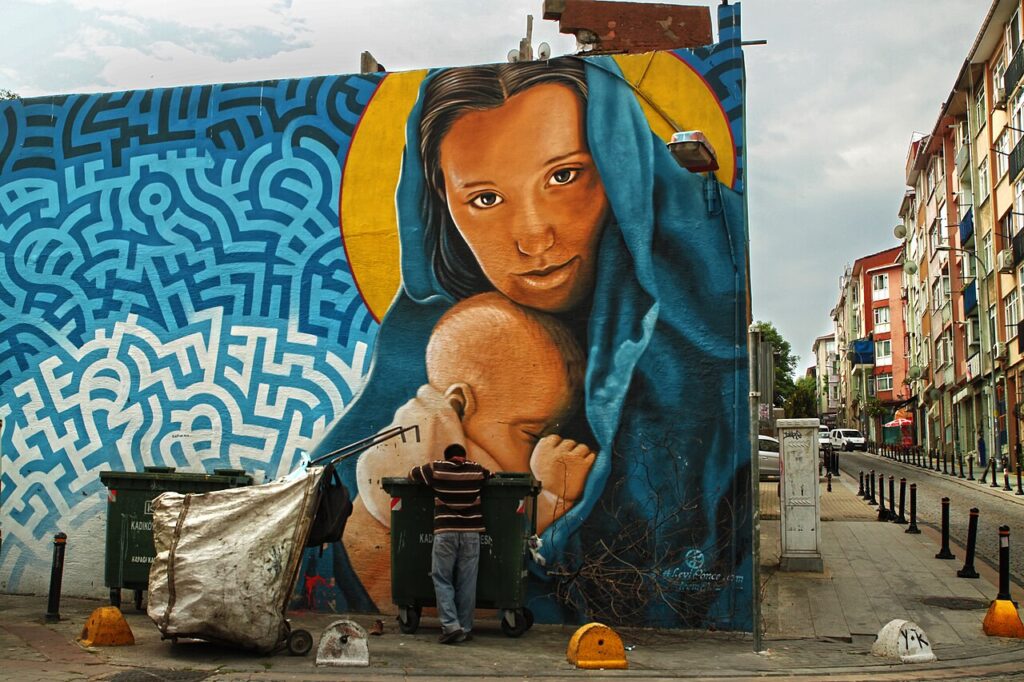
The twentieth century made Kadikoy what it is now. The early republic brought growth and the first waves of the internal migration that would transform Istanbul; the district’s population multiplied, the villages merged into a continuous urban fabric, and the market town became a city district. The postwar decades brought the apartment blocks of the hills and the modernization of the waterfront. And crucially, Kadikoy became the intellectual and cultural capital of the Asian side: the bookshops, the theaters, the cinema culture, the cafes where writers and artists gathered — the identity that the neighborhood wears today was built in the mid-century, when Kadikoy’s coffeehouses and cultural institutions made it the place where the city’s creative life crossed the water. The 1960s and 1970s added the nightlife and the arts scene; the 1990s and 2000s added the vintage shops, the specialty coffee, and the street art that made the neighborhood famous to a new generation of visitors.

The Culture of the Neighborhood Today
The culture of modern Kadikoy is the sum of its history, and it has a character that is instantly recognizable. It is liberal — the most openly progressive corner of Istanbul, a place where the city’s political and social debates happen in public and in earnest. It is artsy: the galleries, the live-music rooms, the independent cinemas, the street-art festival that repaints Yeldeğirmeni every year, the design studios and the roasteries that have made the neighborhood a destination for the city’s young creatives. It is a book town — the bookshops of Bahariye and the used-book sellers are an institution, and the neighborhood’s reading culture is the visible proof of its intellectual inheritance. And it is a food town: the market, the meyhanes, and the breakfast houses are the social life of the district, the expression of a culture that treats the table as the center of the day. The football culture completes the picture — Kadikoy is Fenerbahçe territory, the yellow-and-navy of the club founded in 1907 woven through the streets, and match days are the neighborhood’s great communal ritual.
The Layers, Read Together
The traveler who walks Kadikoy with its history in mind sees the neighborhood in three dimensions. The market sits where the Ottoman market town stood, which sat on the trading ground of Chalcedon. The ferry terminal is the descendant of the boats that have crossed the strait here for millennia. The apartment blocks of Moda are the nineteenth-century summer houses grown up; the murals of Yeldeğirmeni are painted on the walls of the Jewish quarter’s old buildings; the bookshops and the cafes are the mid-century intellectual life, renewed. Every layer is visible to the eye that knows to look, and the neighborhood’s remarkable quality — the sense that it is a real place with a real past, not a stage set for visitors — is the direct result of that depth. Kadikoy is the city’s oldest Asian settlement, its most liveable district, and its most interesting neighborhood — and all three facts are the same fact, read at different depths.
Frequently asked questions
How old is Kadikoy?
The settlement dates to the 7th century BC, when Greek colonists founded Chalcedon — making it older than Byzantium across the strait.
What does the name Kadikoy mean?
“The village of the judge” — named for the court of the religious judge (kadı) that served the Asian-side districts in Ottoman times.
What is the famous legend about Kadikoy?
The Chalcedonians were called “blind” for founding their city on the Asian shore while the obviously superior European site across the water stood empty — the story the oracle told the founders of Byzantium.
Why is Kadikoy known as the cultural capital of the Asian side?
Its bookshops, theaters, cinemas, galleries, and cafe culture — built up through the twentieth century and renewed since — give the neighborhood an intellectual and artistic identity unique on the Asian side.
What is the Council of Chalcedon?
An ecumenical council of the Christian church held in AD 451 near Kadikoy, which produced one of the most important doctrinal definitions in church history — the city’s ancient name on the record forever.
Where can I see the ancient layers?
The archaeology is scattered — the remains of Chalcedon surface in the excavations around the modern district, and the museums of the city hold the finds. The neighborhood’s history is read more in its layers — the market’s site, the street patterns, the buildings of each century — than in a single visible ruin.
How did Yeldeğirmeni get its name?
“The windmill quarter” — the windmills that once turned on its hill gave the district its name, centuries before the street art arrived.
Why is Fenerbahce so central to the neighborhood’s identity?
The club was founded in Kadikoy in 1907, and its yellow-and-navy has been woven through the district ever since — the football culture is part of the same local pride that produced the bookshops and the art scene.
Is there a museum or heritage trail?
The neighborhood’s history is best read on the streets — the synagogue of Yeldeğirmeni, the churches of Moda, the facades of the old apartments, the station — with the city’s museums holding the deeper collections. The bookshops’ local-history shelves are the trail’s best guide.

All Over Information
The All Over Information editorial team researches and writes practical English-language guides to Turkey. Facts are checked against official and local sources before publication, prices are published as dated ranges rather than quotes, and guides are revised when things change. We accept no sponsored posts, paid placements or paid links.
More guides like this

Best Time of Year to Visit Kadikoy
Every season in Kadikoy is someone's favorite, and that is the honest truth about the neighborhood's climate: it has no bad month,…

48 Hours in Kadikoy: The Perfect Itinerary
Kadikoy is the neighborhood that makes Istanbul feel like two cities in one. On the European side, the day is a parade…

Where to Stay in Kadikoy: Neighborhood Guide
Most visitors to Istanbul sleep on the European side, close to the monuments, and cross the water only for a day trip…

Kadikoy in Winter: What to Expect
Kadikoy in winter is the neighborhood's best-kept secret.

A Foodie’s Guide to Kadikoy
Istanbulis will argue for hours about where the city's best food is. The old city has the history, Beyoğlu has the restaurants,…