No single person shaped the skyline of Turkey more than Mimar Sinan, the chief architect of the Ottoman Empire in its golden age. Over a career spanning half a century, he designed hundreds of buildings, from small fountains to the great mosques that still define Istanbul‘s silhouette. His domes seemed to float, his engineering solved problems that had defeated earlier builders, and his work crowned the reign of Suleyman the Magnificent. This article tells his story, from humble beginnings to architectural immortality.
From Apprentice to Architect
Sinan was born around 1490 in a village in central Anatolia, in a Christian family, and his early life gave little hint of the fame to come. As a young man he was recruited into the devshirme, the system by which the Ottoman state gathered boys from its provinces to serve in the palace and the army, and he was trained in the Janissary corps. He learned carpentry and building as part of his military service, and his talent for engineering emerged in the army’s campaigns.
His architectural career began with military works: bridges, fortifications, and the temporary structures that armies need on the march. Sinan’s bridges, built across rivers from the Balkans to Persia, showed his grasp of hydraulics and stone, and his reputation grew with each campaign. By middle age he had risen through the ranks of the imperial building corps, and in 1538, after his work on a campaign in the east, he was appointed chief architect to the empire.
Chief Architect to the Empire
The post of chief architect, or mimarbasi, made Sinan responsible for the empire’s public building program, and it was a position of immense power and prestige. He directed a large staff of draftsmen, surveyors, and masons, and he was personally answerable to the sultan for the empire’s mosques, bridges, aqueducts, and palaces. The appointment also placed him at the center of Ottoman court life, where he would work for the sultans, the grand viziers, and the great ladies of the dynasty.
Sinan held the post for almost fifty years, serving three sultans: Suleyman the Magnificent, Selim II, and Murad III. This extraordinary longevity allowed him to develop his art continuously, and it is one of the reasons his work shows such clear development, from the still-experimental designs of his early career to the confident masterpieces of his later years. Few architects in history have had half a century to perfect their craft.

The Three Great Masterpieces
Sinan’s career is often summarized by three great mosques, each built at a different stage of his development and each a step toward the perfection of the domed mosque. The Sehzade Mosque in Istanbul, completed around 1548, was his first major imperial commission, and its symmetrical, light-filled design established his mature style. It was built in memory of the sultan’s son, and its beauty announced a new era in Ottoman architecture.
The Suleymaniye Mosque, completed in 1557, was his grandest statement, built for Suleyman himself on one of Istanbul’s hills. Its dome, carried on four massive piers, crowns a complex of schools, hospitals, and kitchens that made it a city within the city. The Selimiye Mosque in Edirne, completed in 1574 when Sinan was in his eighties, is regarded as his masterpiece, a dome so perfectly integrated with its structure that he himself called it his masterwork. Together, the three mosques chart his entire journey.
Engineering the Impossible
What makes Sinan’s architecture so remarkable is the engineering behind the beauty. Ottoman builders had struggled to place a dome on a square base without heavy, obstructive supports, and Sinan solved the problem with increasing elegance. He used half-domes, buttresses, and galleries to distribute the weight, and he refined the geometry of his domes until the massive stone shells seemed to hover above their buildings without effort.
His engineering went beyond the mosques. Sinan designed the aqueducts that brought water across the hills to Istanbul, the great public baths with their intricate systems of heating, and the bridges that still carry traffic today. His buildings were built to survive earthquakes and centuries of weather, and their survival is the strongest testimony to his understanding of materials and structure. He was an engineer in the fullest sense, and his architecture rests on his science.
The Suleymaniye Complex
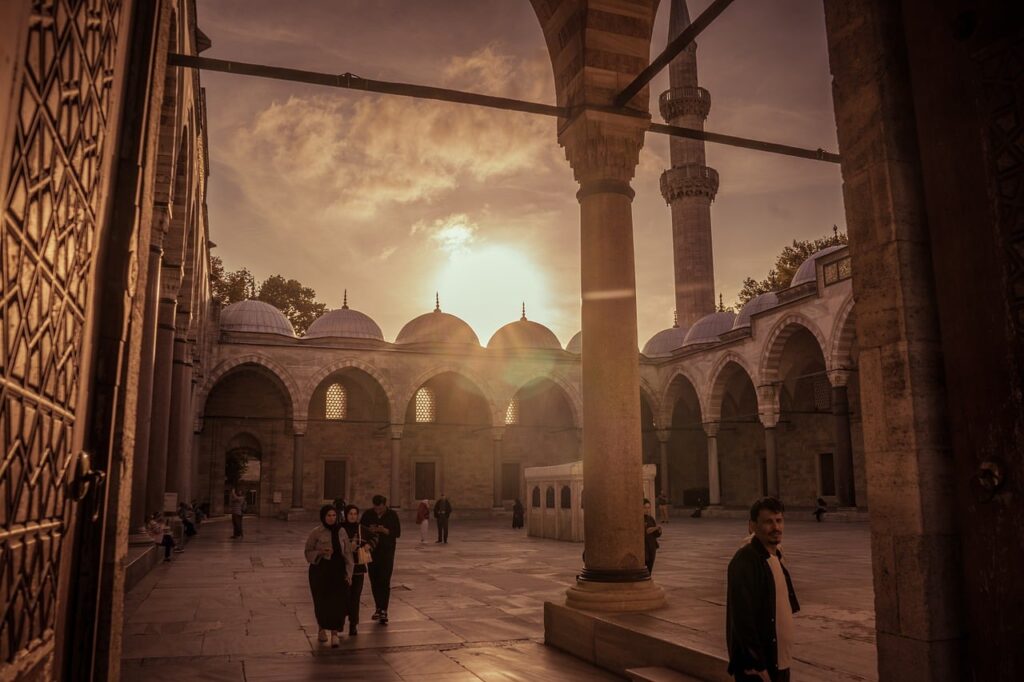
The Suleymaniye is more than a mosque; it is a city within a city, and it shows Sinan’s genius for planning as well as building. The complex, built on one of Istanbul’s hills, gathered together four great schools, a hospital, a soup kitchen, a caravanserai, and the sultan’s tomb, all arranged around the mosque in a carefully composed whole. It was the largest building project of the Ottoman century, and it still functions as a center of learning and culture.
The complex also reveals Sinan’s response to site and landscape. He set the mosque on a terraced platform with gardens cascading down the hill, so that the building commands the city and the water beyond, and he sited the great school buildings to frame views of the Golden Horn. The Suleymaniye is a lesson in how architecture can organize a city, and it remains one of the most satisfying places in Istanbul to simply sit and look.
Patrons and the Building Boom
Sinan worked not only for the sultans but for the great figures of the empire, and their patronage produced an extraordinary building boom. The grand viziers, the sultans’ mothers and daughters, and the provincial governors all commissioned mosques, schools, and charitable complexes, and Sinan designed them all. The women of the dynasty, especially, were among the most active patrons, building the Mihrimah Sultan mosques at Uskudar and Edirnekapi, both masterpieces of his middle years.
This patronage system made Istanbul a forest of domes and minarets within a single generation, and it spread Sinan’s style across the empire, from the Balkans to the Arab provinces. His students and assistants carried the tradition further, and the architecture of the entire Ottoman world for the next two centuries descended from his designs. The building boom he directed changed the face of the empire in a way no single architect has matched elsewhere.

Sinan the Scientist
Sinan’s notebooks and his great autobiographical essay, in which he listed his works and their innovations, reveal a systematic, scientific mind. He experimented with structural systems, recorded the dimensions and solutions of each building, and reflected on the problems of lighting, acoustics, and stability. His mosque interiors are engineered for sound as well as sight, with domes and galleries shaped so that a single speaker can be heard throughout the vast space.
His curiosity ranged beyond the mosque. He studied the ruins of antiquity, learned from the Byzantine masters whose domes had set the challenge he solved, and applied his knowledge of water, stone, and climate to every commission. The tradition of the Ottoman master architect, combining the roles of designer, engineer, and administrator, reached its fullest expression in him, and his working methods prefigure the modern profession of architecture.
The Legacy of Sinan
Sinan died in 1588, in his late nineties, and was buried beside his Suleymaniye in a tomb he designed for himself. His legacy was already enormous at his death: hundreds of buildings across the empire, a school of architects trained in his methods, and a style that became the standard for Ottoman architecture for the next three centuries. Every great Ottoman building that followed, down to the imperial mosques of the eighteenth and nineteenth centuries, descends from his work.
His influence has outlived the empire. Modern architects study his structural logic, and his mosques remain among the most visited buildings in Turkey, admired by travelers who may never know his name. In 2000, a survey by Turkish architects and academics named him the greatest architect in the history of the country, and international scholarship has long recognized him as one of the supreme builders of world architecture, ranked with Brunelleschi and Michelangelo.

Visiting Sinan’s Buildings Today
Sinan’s buildings are among the easiest architectural treasures in the world to visit, because so many are still in daily use. In Istanbul, the Suleymaniye and Sehzade mosques, the Mihrimah Sultan mosques, and the great bath of Cemberlitas are all part of the urban fabric, and the city’s museums hold the documents and models that tell his story. In Edirne, the Selimiye Mosque, a world heritage site, is the essential pilgrimage for anyone who wants to see his genius at its peak.
A practical tour of Sinan’s work can be built around a few visits: a morning at the Suleymaniye, watching light fill the dome he engineered; an afternoon at the Selimiye in Edirne, a short trip from Istanbul; and time for the smaller mosques, baths, and bridges that show the range of his craft. His buildings ask only that you look up, and they repay the effort with some of the most beautiful spaces ever created by human hands.
Sinan’s Lesser Works and Their Legacy
The great mosques can overshadow the rest of Sinan’s output, but his minor works reveal the range of his genius. He designed modest neighborhood mosques with the same care as imperial ones, along with schools, tombs, fountains, and the great covered market of Istanbul.
His engineering projects deserve equal attention. Sinan built the aqueducts that supplied Ottoman Istanbul, the bridges that still carry traffic over Turkish rivers, and the public baths whose domed interiors show his command of light and water.
The true legacy of Sinan, however, is the school he left behind, whose assistants spread his style across the empire and into the following centuries. When you see a dome anywhere in the former Ottoman world, you are seeing the distant reflection of his genius.
Frequently asked questions
Who was Mimar Sinan?
Mimar Sinan was the chief architect of the Ottoman Empire in the sixteenth century, serving three sultans over almost fifty years. Born around 1490 in Anatolia, he rose through the Janissary corps to become the empire’s master builder, designing hundreds of buildings, including the Suleymaniye Mosque in Istanbul and the Selimiye Mosque in Edirne, his acknowledged masterpiece. He died in 1588 and is buried beside the Suleymaniye.
What is Sinan’s most famous building?
The Selimiye Mosque in Edirne, completed when Sinan was in his eighties, is considered his masterpiece and is a world heritage site. The Suleymaniye Mosque in Istanbul, built for Suleyman the Magnificent, is his grandest and most visited work, and the Sehzade Mosque marks his early maturity. All three are essential stops for anyone interested in his architecture.
Can I visit Mimar Sinan’s buildings?
Yes. Most of Sinan’s buildings are still in use and open to visitors, from the great mosques of Istanbul to the Selimiye in Edirne, which is an easy trip from the city. His bathhouses, bridges, and smaller mosques are part of the urban fabric. His tomb stands beside the Suleymaniye Mosque, and Istanbul’s museums display documents and models related to his work.

All Over Information
The All Over Information editorial team researches and writes practical English-language guides to Turkey. Facts are checked against official and local sources before publication, prices are published as dated ranges rather than quotes, and guides are revised when things change. We accept no sponsored posts, paid placements or paid links.
More guides like this

The Architecture of Mevlana Museum Explained
The Mevlana Museum of Konya — the complex of the shrine and the dervish lodge — is the architectural treasure of the…

Visiting Spice Bazaar: Tickets, Hours, and Tips
The Spice Bazaar of Eminönü is one of the most accessible and rewarding sights in Istanbul, a compact, colorful market that you…
Islamic Architecture of the Ottoman Empire
The Ottoman Empire ruled Anatolia and much of the world around it for over six centuries, and it left behind one of…

Why Suleymaniye Mosque Should Be on Your Turkey Bucket List
Most travelers to Istanbul have the Blue Mosque and Hagia Sophia on their lists and treat the Suleymaniye as an optional extra.…

Visiting Chora Church: Tickets, Hours, and Tips
The Chora Church — the Kariye — is one of the great monuments of Istanbul, and the visit to its mosaics and…

Visiting Rumeli Fortress: Tickets, Hours, and Tips
The Rumeli Fortress is one of the most impressive sights on the Bosphorus, a vast medieval castle of towers and walls that…