The Spice Bazaar is one of the finest surviving examples of Ottoman market architecture, a building that has done the same job, in the same form, for more than three and a half centuries. Its architecture is deceptively simple: an L-shaped plan, two long vaulted galleries, a handful of gates, and a few quiet details that repay attention. Yet that simplicity is the result of careful design, worked out by the imperial architects of the seventeenth century and tested by three centuries of fire, earthquake, and constant use. This guide explains how the bazaar is put together, what it is made of, and how to read its design when you walk through it.
The L-Shaped Plan
The most important fact about the architecture of the Spice Bazaar is its plan. The building is shaped like the letter L, two long covered halls meeting at a corner, and that simple shape organizes everything about the market, from the flow of the crowds to the position of the stalls.
The L-shape was a practical choice. It allowed the market to wrap around the corner of the site assigned to it, fitting the building neatly into the dense street pattern of the waterfront district while keeping the whole market under one continuous roof.
The plan also creates a natural circulation. Shoppers enter through the gates, move along the arms of the L, and emerge at the far ends, and the corner where the two arms meet becomes the heart of the market, the most trafficked and the most valuable location of all.
The Vaulted Galleries
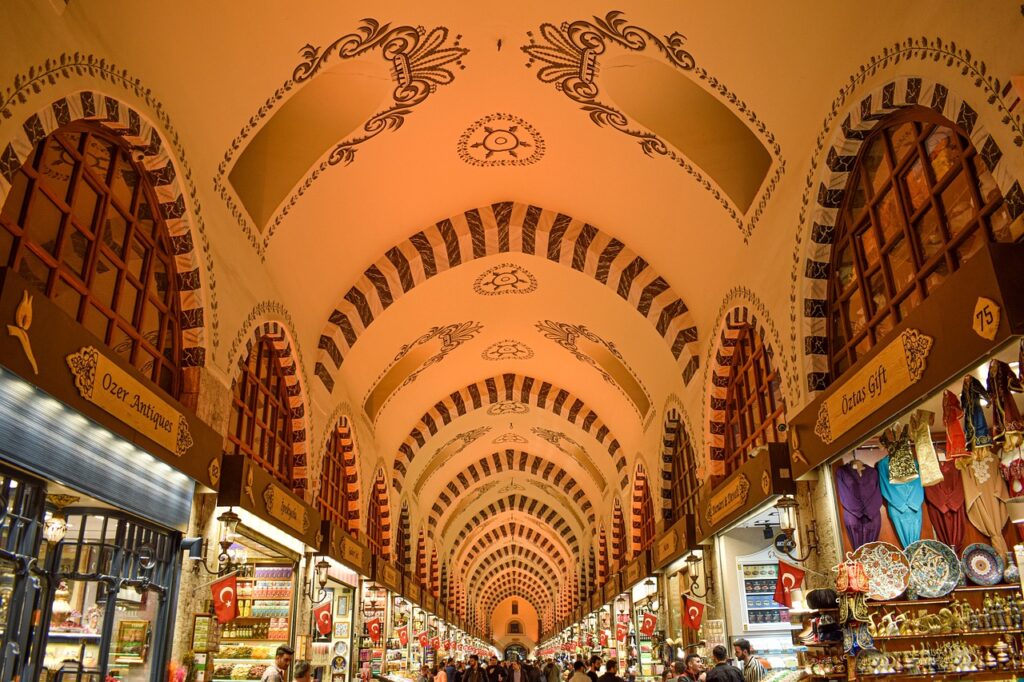
The two arms of the bazaar are covered by long vaulted galleries, and these vaults are the architectural essence of the building. Brick barrel vaults carry the roof over the stalls, sheltering the goods and the shoppers from the weather in the Ottoman manner.
The galleries are wide and generous, built for crowds. The stalls line both sides, the central aisle carries the shoppers, and the height of the vaults keeps the space airy and bright, a design that has proven itself across four centuries of busy trading.
The vaulting is also the building’s structural spine. Every part of the roof bears on the walls and piers that frame the galleries, and the system is so sound that the bazaar has survived earthquakes and fires that destroyed much of the surrounding city, a testimony to the quality of its construction.

The Domes and Lanterns
At key points, the architecture of the Spice Bazaar rises above the ordinary vaults into domes and lanterns. The entrance vestibules are crowned with small domes, marking the gates as special places, and the interiors are lit by lanterns that bring daylight down into the market.
The lighting is a deliberate design feature. The bazaar is a covered space, but it was never meant to be dark; the lanterns and the windows in the vaults admit a controlled, even light that shows the goods at their best and keeps the atmosphere lively.
These domes and lanterns also give the building its silhouette. Seen from the street, the Spice Bazaar reads as a long, low mass, punctuated by the domes of its vestibules, and that profile, together with the great mosque beside it, defines the skyline of the waterfront.
The Six Gates
The Spice Bazaar opens to the city through a series of gates, and these portals are the building’s points of connection with the streets around it. The main gate, on the square beside the Yeni Mosque, is the grandest, marked by its domed vestibule.
The other gates are smaller but equally functional, opening onto the busy lanes of Eminönü and drawing shoppers from every direction. Each gate has its own street life around it, and together they knit the market into the fabric of the neighborhood.
The gates are more than entrances; they are the architectural expression of the market’s openness. A closed market is a fortress, but the Spice Bazaar, with its many doors, is a building designed to be entered, and that openness is part of its success.

The Tower at the Eastern End
One of the most distinctive features of the Spice Bazaar is the tower at its eastern end, a structure that rises above the market and gives the building its most recognizable detail. The tower is part of the bazaar’s original design, built with the market in the 1660s.
The tower served a practical purpose in the life of the complex. It was linked to the administration of the market and the mosque, providing space for the officials and the functions that governed the waqf, the charitable foundation that ran the ensemble.
Whatever its original use, the tower is now one of the bazaar’s signatures, visible from the waterfront and from the approaches to Eminönü. It anchors the eastern end of the building and completes the composition, balancing the domes of the main entrance at the other end.
Materials: Stone, Brick, and Decoration
The Spice Bazaar is built from the classic materials of Ottoman architecture, and the choice of materials explains much about its character. The walls are stone and brick, laid with the precision of the imperial builders, and the vaults are of brick, light, strong, and quick to build.
The decoration is restrained, in keeping with the building’s commercial role. The gates carry inscriptions and carved details, the vestibules have their domes and moldings, but the galleries themselves are plain, letting the goods provide the color, a design decision that has kept the building fresh for centuries.
The materials have also aged beautifully. The stone has softened with time, the brick has taken on warm tones, and the patina of four centuries of use gives the building a depth that no restoration can fully recreate. The architecture is honest, and honesty ages well.
The Yeni Mosque Complex: One Ensemble, Many Parts
The Spice Bazaar cannot be understood in isolation, because it is one part of a larger architectural composition. It was built as the commercial wing of the Yeni Mosque complex, and the mosque, the market, and the spaces between them form a single grand ensemble.
The ensemble is one of the finest of its kind in the Ottoman world. The mosque provides the spiritual and monumental center, the bazaar the economic engine, and the courtyard and the surrounding buildings the everyday life, all designed to work together as one organism.
The visitor experiences this unity directly. You enter the bazaar, emerge onto the square, and step into the mosque courtyard without a clear sense of crossing boundaries, because the architect designed the whole complex as a continuous sequence of spaces, and that flow is the building’s greatest achievement.
Engineering for Fire and Earthquake
The engineering of the Spice Bazaar has been tested as hard as any building in Istanbul, and its survival is a lesson in sound construction. The vaulted brick structure is inherently fire-resistant, which is why the market has outlived so many of the wooden buildings around it.
The stone and brick also behave well in earthquakes. The vaults distribute the loads of the roof evenly, the walls are massive and stable, and the building has absorbed the shocks that have repeatedly damaged the city, emerging each time with repairs rather than ruins.
The twentieth century added modern reinforcement. Restoration campaigns have strengthened the structure, injected new materials into the old walls, and secured the vaults, so that the seventeenth-century building continues to carry the twenty-first-century crowds with the same quiet competence it has always shown.
The Shops and Stalls: Architecture of Commerce
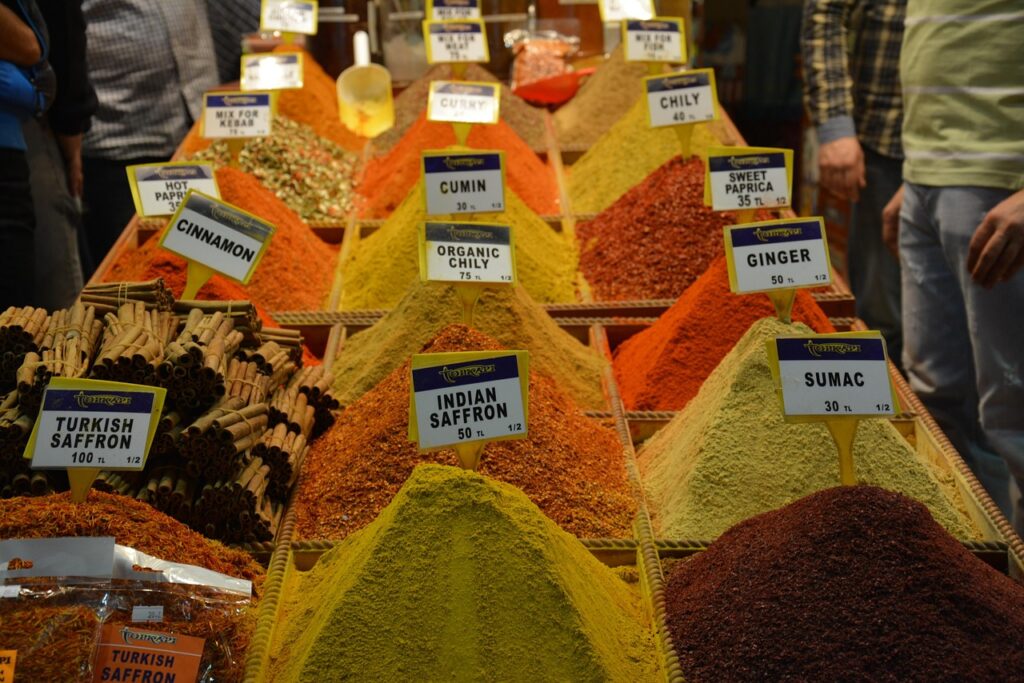
The real architecture of the Spice Bazaar is completed by its shopkeepers, because the stalls are as much a part of the building as the vaults. Each stall is a small stage, framed by the stone piers, open to the aisle, and dressed with the merchant’s display.
The arrangement is the classic bazaar unit: goods in front, merchant behind, and the whole stall open to the passerby. The design encourages the pause, the taste, the conversation, and the sale, and it has proven itself the most efficient retail architecture ever devised.
The stalls also give the building its living texture. The signs, the sacks of spices, and the trays of sweets change the look of the galleries every day, so that the Spice Bazaar is never quite the same building twice. Architecture and commerce, here, are one continuous creation.
Reading the Building Today
To read the Spice Bazaar well, look at the building in layers. The structure, the vaults, the gates, and the tower, is the seventeenth-century original, remarkably complete; the stalls, the signs, and the displays are the living layer of the present day.
The relationship between the two layers is the building’s secret. The old structure was designed to accommodate exactly this kind of commercial life, and the merchants of today use the space exactly as their predecessors did, which is why the market feels so effortlessly authentic.
Stand in the main gallery and take it in. The vaults above you were raised in the 1660s, the tower at the end has watched the waterfront for three and a half centuries, and the merchant at the counter is the latest link in a chain of trade that has never broken. That is architecture at its best: designed, built, and used, generation after generation.
Frequently asked questions
What shape is the Spice Bazaar?
The Spice Bazaar is L-shaped, with two long vaulted galleries meeting at a corner. The plan lets the market wrap around its site while keeping the whole building under one continuous roof, with the corner junction acting as the heart of the market.
When was the Spice Bazaar built?
The Spice Bazaar was built in the 1660s as the commercial wing of the Yeni Mosque complex. It was designed by the imperial architects and has survived in remarkably complete form, with its vaults, gates, and distinctive tower still in place.
What is the tower at the end of the Spice Bazaar?
The tower at the eastern end is part of the market’s original seventeenth-century design. It was associated with the administration of the mosque and market complex, and it now serves as one of the bazaar’s most recognizable architectural features.

All Over Information
The All Over Information editorial team researches and writes practical English-language guides to Turkey. Facts are checked against official and local sources before publication, prices are published as dated ranges rather than quotes, and guides are revised when things change. We accept no sponsored posts, paid placements or paid links.
More guides like this

Visiting Chora Church: Tickets, Hours, and Tips
The Chora Church — the Kariye — is one of the great monuments of Istanbul, and the visit to its mosaics and…

The Architecture of Galata Tower Explained
Galata Tower looks simple at first glance, but it is a sophisticated piece of medieval engineering that has been tested by centuries…
Visiting Basilica Cistern: Tickets, Hours, and Tips
Descending into the Basilica Cistern is one of the most atmospheric experiences Istanbul offers, a step from the noise of the streets…
Grand Bazaar Through the Centuries
Few places on earth can claim more than five and a half centuries of continuous commercial life, and the Grand Bazaar is…

Blue Mosque Through the Centuries
The Blue Mosque has shaped the Istanbul skyline since the early seventeenth century, its six minarets rising over Sultanahmet Square directly opposite…

Seljuk Architecture and Its Distinct Style
When you travel across central Turkey, you will notice buildings that look unlike anything else you have seen: vast stone portals carved…