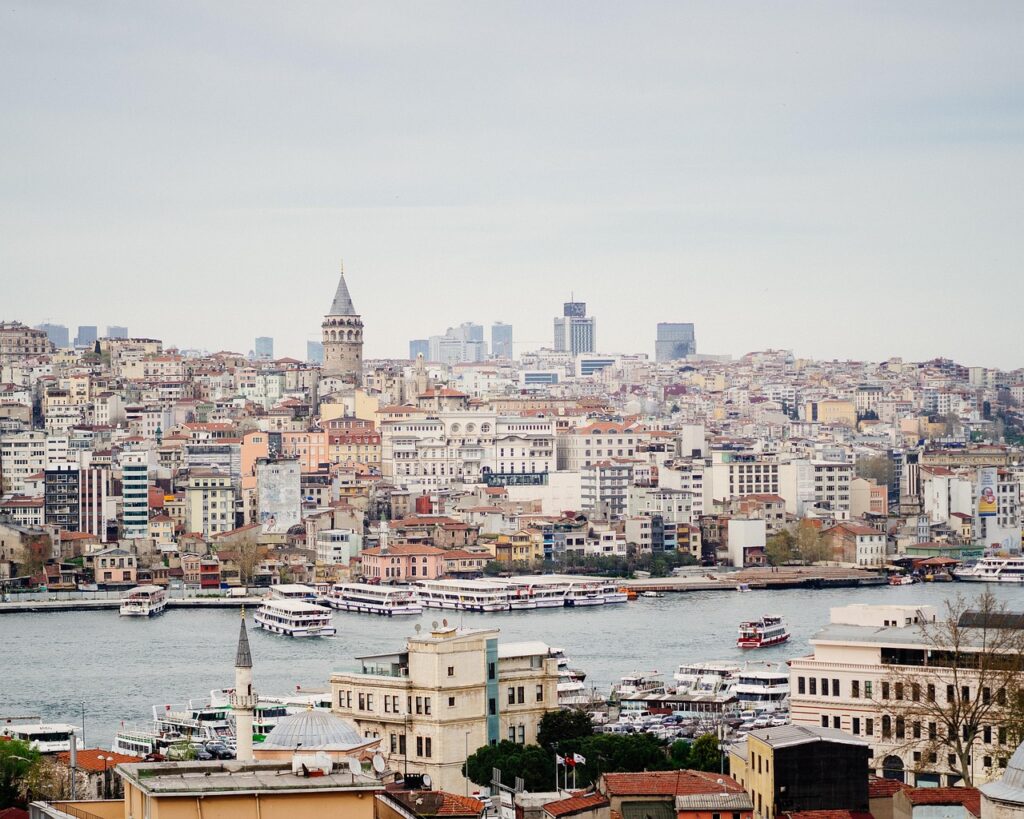
No skyline in the world tells a longer story than Istanbul‘s. From the sea, the city rises in layers: the ancient domes of Hagia Sophia and the Blue Mosque, the medieval Galata Tower, the nineteenth-century palaces along the Bosphorus, and the glass towers of the modern business districts. The old and the new face each other across the water in a dialogue that has been running for sixteen centuries. This guide explains what you are seeing, where to get the best views, and how to read the city’s ever-changing profile.
The Seven Hills and Their Domes
Istanbul was built on seven hills, like Rome, and for most of its history the skyline was defined by the domes and minarets of its great mosques. The silhouette of the old city, seen from the sea, is one of the most famous views in the world. Hagia Sophia’s sixth-century dome and the Blue Mosque’s cascading domes set the tone.
The Ottoman sultans deliberately shaped this skyline. By building their mosques on the highest points, they made the city’s religious and imperial power visible from every approach. The Süleymaniye Mosque, the masterpiece of the architect Sinan, was designed to crown the third hill with perfect geometry.
Today the old city remains remarkably intact. A protected zone keeps new construction low, and the historic skyline survives almost exactly as it was in the sixteenth century. Crossing the Bosphorus by ferry, you can still see the city as travelers have seen it for five hundred years.
The Galata Tower and the European Quarter
On the far side of the Golden Horn rises the Galata Tower, the medieval landmark of the Genoese colony that once controlled the city’s trade. Built in the fourteenth century, it stood at the edge of a walled European settlement that was quite separate from the Byzantine capital across the water.
Around the tower, the nineteenth century transformed the district of Pera into a European-style quarter of grand apartments, embassies, and hotels. The neoclassical facades along Istiklal Avenue and the banks of Galata still stand, a layer of European urbanism grafted onto a Byzantine city.
The Galata Tower gives you one of the classic views of the Istanbul skyline. From its balcony you see the old city’s domes and minarets spread before you, with the Bosphorus and the Asian shore beyond. It is the perfect place to understand how the two halves of the city face each other across the water.
Palaces and the Bosphorus Shore
The Bosphorus strait is lined with the palaces, mansions, and pavilions of the Ottoman elite, and together they form a unique architectural shoreline. The Dolmabahçe Palace, built in the nineteenth century, mixes Ottoman grandeur with European baroque, and its ornate skyline is unlike anything else in the city.
The wooden waterside mansions, the yalı, line the strait’s shores in the neighborhoods of Arnavutköy, Bebek, and Kanlıca. Their bay windows, called cumba, project over the water, and their decorative facades create a romantic, irregular skyline that has changed little in a century.
The Bosphorus boat trip is the best way to see this layer of the city. From the water, the palaces rise directly from the shore, each with its own garden, quay, and landing stage. It is a skyline of private wealth rather than public power, and it tells the story of Istanbul’s long love affair with the strait.
The Bridges That Define the Skyline
Istanbul’s bridges are among the most distinctive elements of its skyline, and the city now has three great crossings over the Bosphorus strait. The first bridge, opened in 1973, linked Europe and Asia for the first time in history. The second followed in 1988, and the third, opened in 2016, carries a highway and a railway far to the north.
Each bridge changed the skyline and the city. The original Bosphorus Bridge, with its elegant steel tower, is now a beloved icon, lit at night and visible from most of the European shore. The bridges have also drawn development northward, creating new districts along the strait.
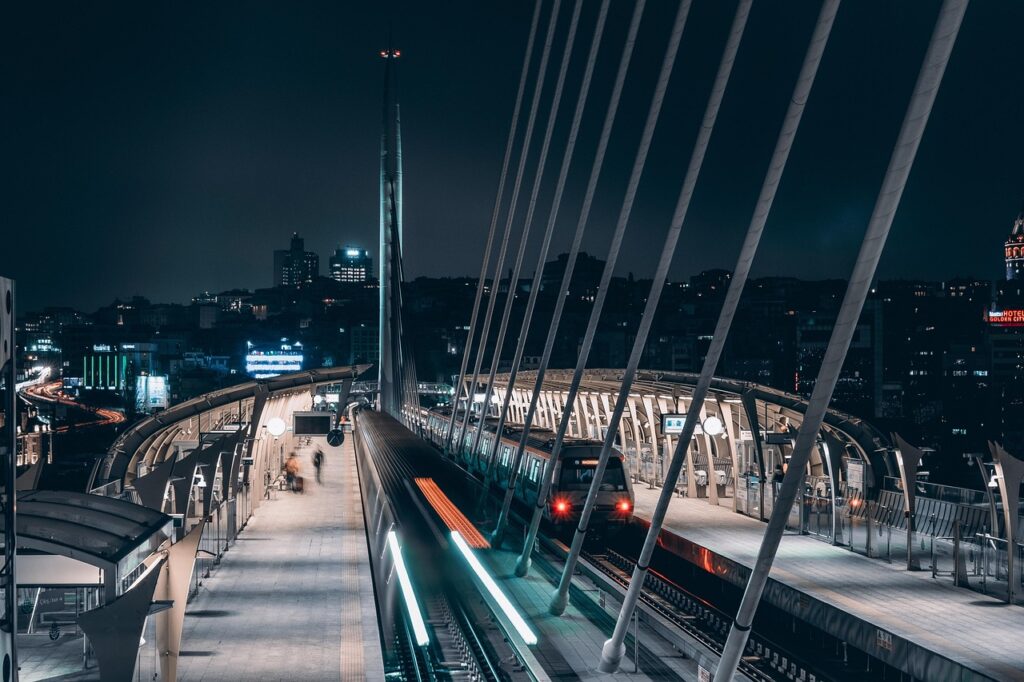
For the visitor, the bridges are both transport and spectacle. Cross one on foot, or simply admire them from a ferry. At night, their lights and the strings of their cables trace elegant arcs across the water, and the city’s ancient domes glow below them in a composition of old and new.

The New Towers of Levent and Maslak
The most dramatic change to Istanbul’s skyline in recent decades has been the rise of the business districts of Levent and Maslak, north of the old city. Here, glass towers climb the hills, forming a modern cluster visible from across the water. The Turkish Petroleum headquarters and the twin towers of the Istanbul Sapphire, the city’s tallest building, anchor the group.
These districts are the product of the building boom that transformed the Turkish economy. Banks, corporations, and international firms occupy the towers, and the districts are connected by metro and a web of highways. At night, the business skyline glitters like a second city.
Some visitors find the contrast jarring; others thrilling. Either way, it is essential to understanding modern Istanbul. The old city preserves the past, while the northern hills build the future, and the two skylines exist in productive tension within a single city.
The Asian Side and the Skyline of Asia
Across the strait, the Asian side of Istanbul has its own skyline, less famous but equally fascinating. The historic neighborhoods of Üsküdar and Kadıköy cluster around their mosques and markets, while the hills behind rise in a cascade of apartment blocks. The Maiden’s Tower stands on its little island in the strait, one of the city’s most photographed landmarks.
From the Asian shore, the view of the European side is the classic panorama: the old city’s domes rising behind the ferries, the Galata Tower, and the modern towers of the north. The Asian side gives you the best light for photographing the European skyline, especially at sunset.
The Asian side is also where you can see the city’s future taking shape. New residential towers line the coast, and the district around the old Haydarpaşa station is being redeveloped. Istanbul is a city that grows in both directions, and its two shores are two halves of one skyline.

Watching the Skyline from the Water
The ferries of Istanbul offer the greatest free show in the city: the skyline moving past you from the water. The classic route runs from the European side to Kadıköy and Üsküdar, crossing the strait in twenty minutes with the old city falling away behind you and the Asian shore rising ahead of you.
Longer routes travel the whole Bosphorus, passing the palaces, the bridges, the villages, and the fortresses. The Marmaray rail tunnel crosses beneath the strait, but the ferries remain the romantic way, and daily commuters still pause to watch the light on the domes.
The best moments are dawn and dusk. At sunrise the old city emerges from the mist; at sunset the minarets turn golden; at night the monuments float above the dark water. Riding a ferry at these hours, you understand why this skyline has inspired poets for a thousand years.
Where to Photograph the Classic View
Every visitor wants the postcard view, and Istanbul offers several classic spots. The terrace of the Süleymaniye Mosque gives a sweeping panorama over the old city and the Golden Horn. The Galata Tower gives the view north and south. The hills of the Asian side frame the European shore at sunset.
The seven hills each offer a different angle, and hotel rooftops provide intimate views over the domes. The Galata Bridge is the perfect spot for photographing the old city from water level, with fishing boats in the foreground.
For the most spectacular composition, plan your shooting around the light. Morning light falls on the European shore; evening light falls on the Asian side. During the golden hour, the minarets and domes glow, and the modern towers in the north catch the last rays of the sun.
Reading the Layers of the Skyline
To truly understand Istanbul’s skyline, train your eye to read its layers. Look for the classical profile of the old city, the medieval tower of Galata, the baroque palaces of the nineteenth century, and the glass towers of the present. Each era of the city left its mark, and the skyline is a timeline in three dimensions.
The layers are not accidental. Each generation of builders chose heights, materials, and positions that responded to the city’s geography and its politics. The sultans built high to dominate; the merchants built near the water to trade; the modern state builds northward because that is where the flat land runs.
Once you can read these layers, the skyline becomes a living document. A single glance from a ferry tells you the entire history of the city. And you will notice that the skyline is never finished: every year, new towers join the composition, and the old domes keep their place, as they have for centuries.
Planning Your Skyline Experience
To get the most from Istanbul’s skyline, plan a sequence of views across your visit. Start with the ferry crossing, which gives you the whole composition at once. Climb the Galata Tower on a clear morning. Watch the sunset from the Asian side, and finish with a night view from the old city.
Check the weather: the famous views need clear skies, and the city’s frequent rain and haze can hide the silhouette. The months of spring and autumn offer the most stable light, while winter brings dramatic storms and crisp air. The Bosphorus views are best in the early morning, before the haze builds.
Finally, remember that the skyline is not only a view but a way of life. Istanbullus cross the strait daily, and the changing light on the water is part of their everyday world. Ride the ferries like a commuter, and the skyline will reward you with moments that no postcard can capture.
Frequently asked questions
What is the best time of day to see the Istanbul skyline?
The golden hours around sunrise and sunset are the most beautiful, when the domes and minarets glow in warm light. Morning is best for views from the European side, and evening for views from the Asian side. Night views are spectacular when the monuments and bridges are illuminated.
Which is Istanbul’s tallest building?
The Istanbul Sapphire in the Levent district is the city’s tallest building, rising with its spire to about 261 meters. It belongs to the modern business skyline north of the old city, far from the historic peninsula, where strict height limits protect the silhouette of the ancient monuments.
Can you still see the classic skyline of domes and minarets?
Yes. The historic peninsula is protected by height restrictions, so the skyline of Hagia Sophia, the Blue Mosque, and the Süleymaniye Mosque survives almost intact. From the water, and from the Asian side, you can still see the city much as it appeared in Ottoman times.

All Over Information
The All Over Information editorial team researches and writes practical English-language guides to Turkey. Facts are checked against official and local sources before publication, prices are published as dated ranges rather than quotes, and guides are revised when things change. We accept no sponsored posts, paid placements or paid links.
More guides like this

Why Chora Church Should Be on Your Turkey Bucket List
The Chora Church — the Kariye — is the greatest treasure of the Byzantine art in Istanbul, and one of the essential…

The Architecture of Mevlana Museum Explained
The Mevlana Museum of Konya — the complex of the shrine and the dervish lodge — is the architectural treasure of the…

Best Time to Visit Aspendos Theatre to Avoid Crowds
The theatre of Aspendos is one of the most popular excursion destinations on the Turkish Riviera, and on a busy summer day…
Best Time to Visit Grand Bazaar to Avoid Crowds
The Grand Bazaar is one of the busiest places in Istanbul, and for much of the day its lanes are packed with…

Best Time to Visit Topkapi Palace to Avoid Crowds
Topkapi Palace is one of the most visited museums in the world, and its crowds are legendary: queues at the ticket gates,…
Why Hagia Sophia Should Be on Your Turkey Bucket List
Every travel list for Turkey includes Hagia Sophia, and the lists are right. This is not a monument you visit to tick…