Ask most travelers what religion they expect to find in Turkey and the answer is usually one word: Islam. That is true for the majority, but it is far from the whole story. Turkey is a land where Christianity was born and spread, where the world’s oldest Jewish communities thrived, and where Islam itself took distinctive local forms like Alevism and Sufism. Churches, synagogues, and monasteries still stand across the country, and some still hold services. This guide introduces the religious diversity beyond the mosque, and shows you where and how to experience it.
More Than One Faith
Turkey sits at the meeting point of continents, and its religious map reflects that position. For millennia, the peoples of Anatolia have practiced an extraordinary range of faiths, from ancient pagan cults to the world’s great monotheistic religions, and each has left its mark on the landscape.
Today the overwhelming majority of Turkish citizens are Muslims, and the visible rhythm of daily life follows Islamic custom. But the country also hosts Christian communities of several traditions, a small and ancient Jewish community, and the Alevi tradition, which millions of Turkish Muslims follow as a distinct path.
For the traveler, this diversity is a gift. Within a single day you can move from a mosque to an Orthodox church to a synagogue, from a Sufi lodge to an Alevi gathering house, and the history of each adds depth to the places you visit. Religious diversity is not a footnote in Turkey; it is a central theme.
Christianity’s Ancient Roots
Christianity was born in the eastern Mediterranean, and Anatolia was among its earliest heartlands. The apostle Paul was a native of Tarsus, in southern Turkey, and his missionary journeys crisscrossed the country, founding the churches to which the New Testament’s letters are addressed.
The first Christian councils met on Turkish soil. The Council of Nicaea in 325, which shaped the creed recited in churches worldwide, gathered at Iznik, and other pivotal councils met at Ephesus and Chalcedon. The landscapes of Turkey are therefore sacred to Christians everywhere.
For centuries, Anatolia was deeply Christian. The cave churches of Cappadocia, the monasteries of the Black Sea mountains, and the great pilgrimage sites of the Aegean all bear witness to a Christian civilization that flourished here for over a thousand years, and whose descendants still live in Turkey today.

The Orthodox Tradition
The Orthodox Church, the dominant form of Christianity in the eastern Mediterranean, has deep roots in Turkey. Constantinople, now Istanbul, was the seat of the Ecumenical Patriarch, the spiritual leader of Orthodox Christians worldwide, and the city’s great churches are monuments to that legacy.
Hagia Sophia and the other Byzantine churches of Istanbul still draw pilgrims and visitors, and the Ecumenical Patriarchate in the Fener district remains the center of Orthodox Christianity. In Cappadocia and along the Black Sea coast, cave churches and monasteries preserve the devotional art of Orthodox monks.
Today the Greek Orthodox community of Turkey is small but active, and its liturgical life continues in Istanbul and on the Princes’ Islands. For Orthodox Christians, Turkey is a pilgrimage land, and for other visitors it offers a window into the living traditions of Eastern Christianity.
The Armenian and Syriac Churches
Armenia’s ancient homeland stretched across eastern Turkey, and the Armenian Apostolic Church, one of the oldest Christian communities in the world, still maintains churches and monasteries here. The carved church of Akdamar on Lake Van and the ruins of Ani are among its most extraordinary monuments.
The Syriac Orthodox Church, whose liturgy descends from the Aramaic world of early Christianity, survives in southeastern Turkey. The monastery of Mor Gabriel, founded in the fourth century, still functions near Midyat, and the churches of Mardin and the Tur Abdin plateau preserve an unbroken tradition.
These communities are small now, but their spiritual importance is global. Their ancient liturgies, chanted in languages of the early church, continue to attract pilgrims and scholars, and visiting their monasteries is like stepping back into the first centuries of Christian history.

Jewish Life in Turkey
Judaism has a presence in Anatolia stretching back over two thousand years, and Turkish Jewish history is remarkable for its continuity. The greatest chapter began in 1492, when Jews expelled from Spain found refuge in the Ottoman Empire and built flourishing communities.
Today the Jewish community of Turkey is concentrated in Istanbul, with smaller communities in a few other cities. The community maintains synagogues, schools, and cultural institutions, and its heritage is preserved in the Jewish Museum of Istanbul and the historic neighborhoods of the Golden Horn.
For visitors, the traces of Jewish life are all around: in the street names of Balat, the synagogues of the old quarters, and the cuisine of the city’s historic restaurants. The story of Ottoman welcome remains a proud and defining part of Turkish Jewish identity.
Alevism: A Distinctive Path
Alevism is one of Turkey’s most important and least understood religious traditions. It is a distinct path within Islam that blends elements of Shia devotion to the family of the Prophet, Sufi mysticism, and Anatolian folk religion, and it is followed by millions of Turkish citizens.
Alevi worship does not center on the mosque. Its ceremonies, known as cem, take place in gathering houses called cemevi, and include music, poetry, and the whirling semah dance. Alevi practice emphasizes inner faith, hospitality, and respect for all creation, and it has its own calendar of festivals.
Alevism shapes Turkish culture far beyond its own community. Alevi musicians, poets, and traditions are central to Turkish folk culture, and figures like the thirteenth-century mystic Haci Bektas Veli are revered across the country. Encountering Alevi culture, in its gathering houses, festivals, or music, is a highlight of understanding Turkey.

Sufism and Spiritual Practice
Sufism, the mystical dimension of Islam, has a profound presence in Turkey. The Sufi orders, known as tarikats, developed spiritual disciplines of prayer, meditation, and music, and their lodges were centers of culture and charity across the Ottoman world.
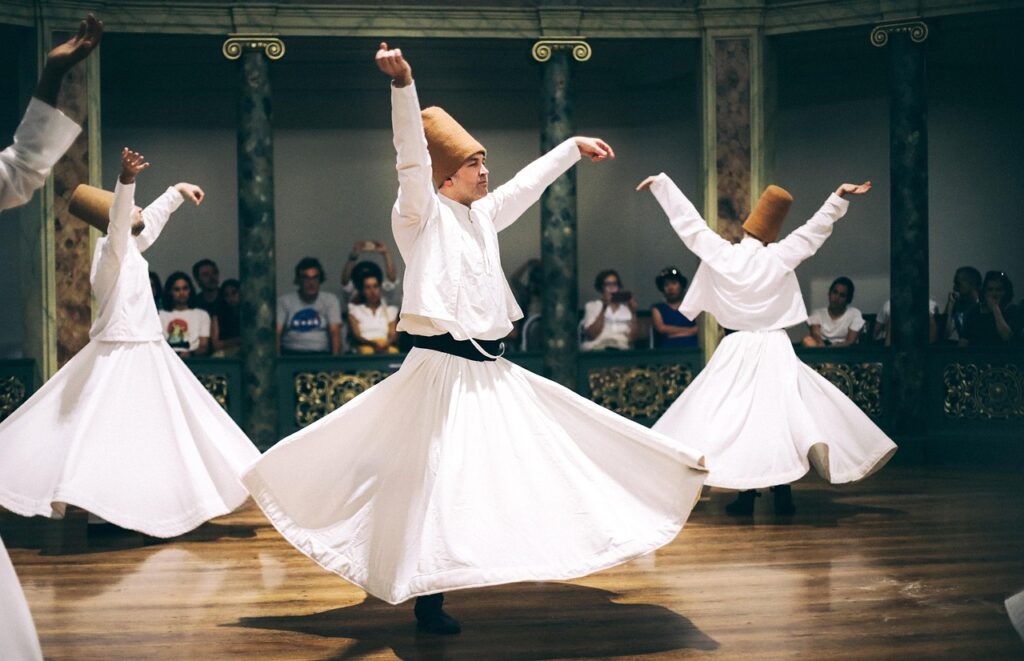
The most famous Sufi tradition is that of Mevlana, the poet and mystic known in the West as Rumi, whose order is famous for the whirling ceremony of the sema. His shrine in Konya draws pilgrims from around the world, and the whirling dervishes perform in cities across Turkey.
Sufism also left a deep mark on Turkish music, poetry, and art. The calligraphy, the classical music, and the meditative architecture of Ottoman Turkey all carry Sufi influence, and for many visitors, the spiritual atmosphere of Sufi practice is among the most memorable experiences of their trip.
Faiths Side by Side
One of the most striking features of Turkish religious life is coexistence. In the southeastern city of Mardin, churches, monasteries, and mosques share the same skyline, as they have for centuries. In Istanbul, a Byzantine church, a Sephardic synagogue, and an imperial mosque may stand within a few hundred meters of each other.
This coexistence has a long history. The Ottoman Empire organized society by religious community, and while the system was far from equal, it preserved and protected non-Muslim communities for centuries. The republic inherited this plural landscape, and many cities still reflect it.
For travelers, the lesson is to look closely. The small church beside a mosque, the synagogue down a side street, the monastery on the hill, all are part of the same story. Reading the religious map of Turkey means learning to see all the faiths, not just the largest one.
Festivals and Shared Customs
Turkey’s religious calendar is a year-round celebration of diversity. Alongside the Islamic festivals of Ramadan and the two bayrams, the Christian communities celebrate Easter and Christmas, and the Alevi tradition marks its own observances, including the spring festival of Nevruz.
These festivals bring communities together in ways that cross boundaries. At Easter, the Patriarchate in Istanbul holds services attended by Orthodox Christians from many countries. At Ramadan, Muslims invite friends of all faiths to share the iftar meal. Neighbors of different religions regularly congratulate each other on their festivals.
For travelers, this shared rhythm is an invitation. Attending a festival, whatever its tradition, is one of the best ways to experience Turkey’s religious life directly, and the welcome is usually warm. Ask locally about celebrations during your visit; you may be surprised what you find.
Exploring Respectfully
Exploring Turkey’s religious diversity calls for the same respect you would bring to any sacred space. Dress modestly at religious sites, remove shoes where required, and follow the guidance of local worshippers. Photography rules differ from place to place, so ask first.
Worship spaces are living places, not museums. If a service or ceremony is underway, observe quietly or return later. In some churches, monasteries, and gathering houses, a contribution or a polite request to see inside is appropriate, and community members are often happy to explain their traditions.
Above all, come with curiosity rather than expectations. Turkey’s religious diversity is a complex, living reality, and the more open you are, the more it will teach you. The traveler who explores with respect will leave with a far richer understanding of this ancient land.
Frequently asked questions
What religions are practiced in Turkey today?
The majority of Turkish citizens are Muslims, including both Sunni Muslims and the millions who follow the Alevi tradition. Christianity is present through the Greek Orthodox, Armenian, and Syriac churches, and there is a small but historic Jewish community. Sufi orders and local folk traditions also remain active. Nearly all of these communities have deep roots in Anatolia that reach back over a thousand years.
Are non-Muslim religious sites open to visitors?
Many are, with practical conditions. Major monuments like Hagia Sophia and the Byzantine churches of Istanbul are open to all visitors, and the Syriac monasteries of the southeast welcome travelers. Synagogues and some active churches require advance arrangement for security and scheduling reasons, often through the community or a museum. Dressing modestly and respecting services are expected everywhere.
How does religious diversity affect daily life in Turkey?
The public rhythm of life follows Islam, with the call to prayer and Islamic holidays shaping the calendar, but non-Muslim communities maintain their own churches, synagogues, and festivals openly. In cities like Istanbul and Mardin, neighbors of different faiths have coexisted for centuries. The state protects the recognized minorities and their places of worship, and religious diversity remains a visible and valued part of Turkish life.

All Over Information
The All Over Information editorial team researches and writes practical English-language guides to Turkey. Facts are checked against official and local sources before publication, prices are published as dated ranges rather than quotes, and guides are revised when things change. We accept no sponsored posts, paid placements or paid links.
More guides like this
Understanding Traditional Turkish Folk Instruments
Turkish folk music is carried by a family of instruments that most visitors hear before they ever see them: the twang of…

Turkish Superstitions You Should Know
Turkey is a land of deep tradition, and superstitions are woven into everyday life in ways that still surprise visitors.

A Deep Dive into the Role of Tea in Daily Turkish Life
Tea in Turkey is not a drink but a system: an agricultural industry on the Black Sea coast, a brewing technology built…

Understanding Ebru Marbling Art
Ebru is the Turkish art of marbling: painting on the surface of water, then transferring the image to paper.

Traditional Turkish Barbershops and Their Rituals
Step into a traditional Turkish barbershop, and you enter a world of warm towels, flickering flames, and rituals that have been refined…

Contemporary Turkish Literature Explained for Foreigners
Contemporary Turkish literature can feel like a vast, unknown territory for foreign readers, but it is one of the most rewarding literary…